This was one of the best concert experiences of this year, the Turbanator rocked the house!
Here's a short review I posted elsewhere:
Holy smokes! Smith was da shit, as they say!!!!!!!!
The band really got it together in the second (almost 90 minute! the first was more than an hour already) set. They did some standards (Sweet and Lovely, Willow Weep for Me, a beautiful alto feature Harlem Nocturne), the Beatles' Come Together in the funkiest ever version, and several Smith originals - great great music, loud and stinky as that kind of music ought to be! (I did some thinking and I'm quite sure Larry Goldings' Trio was the only organ group I've heard live before... now that was a whole different thing last night!)
The encore closes disc 1, as the second set + encore was too long for one CDR.
The sound rating is conservative, the sound was shitty at the concert, and I think I caught it about as good as possible with my equipment.
**********************************************************
Dr. Lonnie Smith & The Original Grooves
jazznojazz 2007
Zurich (Switzerland), Theater an der Sihl
November 3, 2007
Dr. Lonnie Smith - organ & voice
Miguel Martinez - alto sax
Martien Oster - guitar
Gijs Dijkhuizen - drums
CD1/78:51
Set1/67:36
1. Stage Intro + Dr. Lonnie Smith Warmup (2:14)
2. Sweet and Lovely (Arnheim-LeMare-Tobias) 9:34
3. Back Track (Smith) 16:29
4. The Whip (Smith) > Ann MO (17:57)
5. unknown > Ann MO (8:25)
6. Scream (Smith) 12:55
Encore from Set2
7. unknown (11:15)
CD2/Set2/76:18
1. Applause + Warmup (0:55)
2. Willow Weep for Me (Ann Ronell) 22:32 >
3. Mambo (George Shearing) > Ann MO (18:52)
4. Harlem Nocturne (Earle Hagen) 7:05
5. A Smooth One (Charlie Christian) > Ann MO (10:17)
6. Come Together (Lennon-McCartney) 16:34
TT: 155:09
Sound: B+
Source: audience recording (mono to MD)
Lineage: crappy Sony mic > MD > analogue to HD > Cool Edit Pro > FLAC (8,asb,verify)
Taped, transferred & shared by ubu
Note:
This is the complete set, taped from the gallery to the side of the stage (only location where it was possible to tape at all, on the floor it was standing room only and very crowded).
I cut some atmosphere before and some applause after the encore, would have been a bit too long to fit on one disc with set 1, otherwise
Please help identifying CD1#5 and CD1#7 - both are very familiar!
Friday, November 16, 2007

Thursday, November 15, 2007
Lester Young Live (2/16) - with Buck Clayton, Coleman Hawkins, Illinois Jacquet & others (For Europeans Only #3)
So Volume 1 was mostly the well-known (I assume) soundtrack of Gjon Mili's film "Jammin' the Blues" and some added rarities by the Lee & Lester Young band, as well as the two absolutely stunning tracks by the piano-less quintet of Pres, Shad Collins, John Collins, Nick Fenton and Doc West.
Here, for starters you'll get a terrific Jubilee All Stars date with Buck Clayton, Coleman Hawkins and others. On we go with some JATP again with Clayton, Hawkins, and also Illinois Jacquet. Then, to end this volume, we get the first recordings of Pres' regular working unit from 1948, live from the Royal Roost.

From "The Sound of Jazz" (l. to r.): Billie Holiday, Lester Young, Coleman Hawkins, Gerry Mulligan
A note on Pres and JATP: I don't think that all of the JATP material with Pres that was eventually collected in the great 10CD 1944-1949 JATP box on Verve was included in this 16CD set - the JATP discography is a mess, if you compare the info from the Verve box, which I assume is as well-researched as can be, with the crappy info on jazzdisco.org (see links on the right), you'll see what chaos there is... I have not done any comparison myself, but maybe once these 16 volumes are up, I might check and add additional material later.
Lester Young – Live and private recordings in chronological order
Disc 2 /1946-1948
Ca. April 22, 1946
Jubilee All Stars
AFRS Jubilee #190/192, Hollywood, CA
Buck Clayton t; Coleman Hawkins & Lester Young ts; Kenny Kersey p; Irving Ashby g; Billy Hadnott b; Shadow Wilson d
1. Sweet Georgia Brown (Pinkard-Bernie-Casey) 8:20
2. Oh, Lady Be Good (G. & I. Gershwin) 4:06
3. I Got Rhythm (Gershwin) 8:33
May 27, 1946
Jazz At The Philharmonic
Carnegie Hall, New York City
Buck Clayton t; Coleman Hawkins, Illinois Jacquet & Lester Young ts; Kenny Kersey p; Curley Russell b; J. C. Heard d
4. Oh, Lady Be Good (G. & I. Gershwin) 10:45
5. Sweet Georgia Brown (Bernie-Pinkard-Casey) 7:36
These two titles were eventually released on the Verve 10CD JATP box
November 27, 1948
Lester Young Band
Royal Roost, New York City
Jesse Drakes t; Ted Kelly tb; Lester Young ts; Freddie Jefferson p; Ted Briscoe b; Roy Haynes d
6. Jumpin’ With Symphony Sid (Young) 0:44
7. Lester Leaps In (Young) 3:05
8. A Ghost Of A Chance (Young-Washington-Crosby) 4:36
9. Just You, Just Me (Greer-Klages) 5:09
10. Sweet Georgia Brown (Bernie-Pinkard-Casey) 5:09
same date, add Kai Winding tb; Allen Eager ts; Hank Jones p; Ray Brown b; Ella Fitzgerald voc; probably omit Jefferson and Briscoe, maybe Kelly
11. How High The Moon (Morgan Lewis) / Jumpin’ With Symphony Sid (Young) 7:17
MC: Symphony Sid

Here, for starters you'll get a terrific Jubilee All Stars date with Buck Clayton, Coleman Hawkins and others. On we go with some JATP again with Clayton, Hawkins, and also Illinois Jacquet. Then, to end this volume, we get the first recordings of Pres' regular working unit from 1948, live from the Royal Roost.

From "The Sound of Jazz" (l. to r.): Billie Holiday, Lester Young, Coleman Hawkins, Gerry Mulligan
A note on Pres and JATP: I don't think that all of the JATP material with Pres that was eventually collected in the great 10CD 1944-1949 JATP box on Verve was included in this 16CD set - the JATP discography is a mess, if you compare the info from the Verve box, which I assume is as well-researched as can be, with the crappy info on jazzdisco.org (see links on the right), you'll see what chaos there is... I have not done any comparison myself, but maybe once these 16 volumes are up, I might check and add additional material later.
Lester Young – Live and private recordings in chronological order
Disc 2 /1946-1948
Ca. April 22, 1946
Jubilee All Stars
AFRS Jubilee #190/192, Hollywood, CA
Buck Clayton t; Coleman Hawkins & Lester Young ts; Kenny Kersey p; Irving Ashby g; Billy Hadnott b; Shadow Wilson d
1. Sweet Georgia Brown (Pinkard-Bernie-Casey) 8:20
2. Oh, Lady Be Good (G. & I. Gershwin) 4:06
3. I Got Rhythm (Gershwin) 8:33
May 27, 1946
Jazz At The Philharmonic
Carnegie Hall, New York City
Buck Clayton t; Coleman Hawkins, Illinois Jacquet & Lester Young ts; Kenny Kersey p; Curley Russell b; J. C. Heard d
4. Oh, Lady Be Good (G. & I. Gershwin) 10:45
5. Sweet Georgia Brown (Bernie-Pinkard-Casey) 7:36
These two titles were eventually released on the Verve 10CD JATP box
November 27, 1948
Lester Young Band
Royal Roost, New York City
Jesse Drakes t; Ted Kelly tb; Lester Young ts; Freddie Jefferson p; Ted Briscoe b; Roy Haynes d
6. Jumpin’ With Symphony Sid (Young) 0:44
7. Lester Leaps In (Young) 3:05
8. A Ghost Of A Chance (Young-Washington-Crosby) 4:36
9. Just You, Just Me (Greer-Klages) 5:09
10. Sweet Georgia Brown (Bernie-Pinkard-Casey) 5:09
same date, add Kai Winding tb; Allen Eager ts; Hank Jones p; Ray Brown b; Ella Fitzgerald voc; probably omit Jefferson and Briscoe, maybe Kelly
11. How High The Moon (Morgan Lewis) / Jumpin’ With Symphony Sid (Young) 7:17
MC: Symphony Sid

Abdullah Ibrahim - solo recital in Zurich

Last night I went to hear the surviving master of South African jazz in a solo recital in Zurich, Switzerland (which happens to be my hometown, for those who didn't know). He was scheduled to play a 75 minute set at the Neumünster church (which is actually in walking distance from our place), but the concert started at 8 p.m. and Ibrahim played until 10:20 p.m. - clearly he was in a good mood! And he got two standing ovations between sets (roughly 75, 30 and 20 minutes). The first part started out a bit muted, very soft and slow, but after a few minutes I was deeply inside his music. He went on improvising in a soft way, mostly at slow tempos, but the music developed into kind of a maelstrom, pulling me in deeper and deeper.
In the second improvisation, he used some motifs from his famous song-like compositions, with a little groove building up here and there, but still always at slow tempos and masterfully building his improvisation. The third set then he opened with Duke Ellington's hymn "Come Sunday", seguing into a Monk tune, some of his own tunes, and also playing "Memories of You" (see his CD "African Sun" for a marvellous version of that standard, in quartet with Kippie Moeketsi). That third set was where the "jazz" part came in, with Ibrahim playing more rhythmically, and eventually swinging hard, but still at a very relaxed, slow tempo. In short: a very fascinating and mesmerising evening!
PS: alas my recording device did not work, so don't wait for this to show up on dime!
Wednesday, November 14, 2007
Woody Shaw's "Song of Songs" and Concord Music Group
So after all the ranting you have heard from me here and elsewhere, here's a good word about Concord, for a change! By chance (ok, not quite - by googling the info and a cover scan for a vinyl-rip MP3 version of Woody Shaw's "Song of Songs", a disc I had given up ever being able to find and thus went for the recent share on another blog) I happened to see that Concord had that by now - I thought - OOP and hard to find Woody Shaw disc up for takers on their site. I remembered from their special cleanout sale from last year that they'd only ship in the US, but I thought heck why not give it a try, and indeed they do now also cater to the international customer.
And now the best news: the order, sent in three hours ago, has already been shipped!
Here's the Woody Shaw disc, and a quick search yielded some other things that I tought were OOP, like the two Gil Melle CDs, and all of Gigi Gryce's OJC CDs!
And now the best news: the order, sent in three hours ago, has already been shipped!
Here's the Woody Shaw disc, and a quick search yielded some other things that I tought were OOP, like the two Gil Melle CDs, and all of Gigi Gryce's OJC CDs!
Lester Young Live (1/16) - Some Lester a day keeps the doctor away - For Europeans Only #2
Here's the first in a long-ish series of Lester Young uploads. I might some day put some of it up on dime in lossless, too. But as some of this material has seen commercial release, even if only on Chronogical Classics, Masters of Jazz or similar series, it will be rather complicated to figure out what exactly would be allowed there, and what not. So for a beginning, here's VBR MP3s of about as much live Prez you can hope for...
This is a continuation of my little "for Europeans only" series - this material is all out of copy right in Europe, so it's perfectly legal for anyone to share it, even sell it (as those shady labels like Lonehill, Definitive, Gambit etc. do). If you have any doubts or moral constraints, just stay away, please!
This Lester Young Series will consist of 16 CDs, taken from a Japanese Set (also available in LP form, long OOP of course). I will possibly add some bonus items later, too. And it might take me a whole while to put all of this up, so I suggest you subscribe to the RSS-feed not to lose touch if I end up in limbo for a while again... (though limbus, coolest place between heaven and hell, has now officially been abolished... it wasn't fair anyway to let the early-borns and non-christened children stay in a... well, subsidiary of hell... anyway, now there's a room for rent in hell, a chance not to miss! And play "Limbo Jazz" from the Impulse album Duke Ellington Meets Coleman Hawkins for some cool sounds! And add "The Ricitic" and you'll sure be in heaven!)

The first and so far only instalment of my little "For Europeans only" series was dedicated to the great Lee Wiley, the files have been deleted by now (Rapidshare has changed its policy anway, much less will stay online, and I'm not buying an account, so act quick if you want this!). If there's demand, I can also upload my Wiley compilation again, find all info in this older post.
Lester Young – Live and private recordings in chronological order
Disc 1 /1941-1946
July 6, 1938
Jam Session
WNEW Studios, New York City
Benny Goodman cl; Lester Young ts; Teddy Wilson p; others unknown (?)
1. unidentified (?) 3:31
Between February 27 and March 17, 1941 (February 15, 1941?)
Lester Young & his Band
Manhattan Center, New York City
Shad Collins t; Lester Young ts; John Collins g; Nick Fenton b; Doc West d
2. Tickle Toe (Young) 5:25
3. Taxi War Dance (Basie-Young) 5:19
December 2, 1941
Lester & Lee Young’s Band
Club Capri, Hollywood
Paul Campbel t; Lester Young & Bumps Myers ts; Jimmy Rowles p; Red Callender b; Lee Young d
4. Untitled Original (Young) / Blues (Theme) 3:36
1941/1942
Unknown Band
Trouville Club, Los Angeles (Porter: prob. Club in Hollywood)
Lester Young ts, prob. voc; others unknown
5. Just A Little Bit South of North Carolina (Skylar-Cannon-Shaftel) 3:04
August, 1944
Jammin’ the Blues
Hollywood/Los Angeles, CA
Harry Edison t; Lester Young ts; Marlowe Morris p; Barney Kessel g; Red Callender b; Sid Catlett d
6. The Midnight Symphony (Young) 3:02 Morris, Young, Edison, Young
Young ts; Morris p; Kessel g; Callender b; Catlett d; Marie Bryant voc
7. On The Sunny Side of The Street 3:14 Bryant, Young, Bryant (with Young)
(Fields-McHugh)
Edison t; Dickie Wells tb; Young ts & Illinois Jacquet ts; Morris p; Kessel g; Callender b; Catlett d
8. Sweet Georgia Brown (Bernie-Pinkard-Casey) 5:18 Morris, Young, Edison, Kessel, Catlett, Young
Edison t; Wells tb; Young ts; Morris p; Kessel g; Callender b; Catlett d; Bryant voc
9. If I Could Be With You (Johnson-Creamer) 2:12 Young, Wells, Bryant, Edison, Young
Edison t; Wells tb; Young & Jacquet ts; Morris p; Kessel g; Callender b; Catlett d
10. Blues For Marvin (Young) 4:49 Young, Wells, Edison, Kessel, Jacquet, Young
Edison t; Young & Jacquet ts; Morris p; Kessel g; John Simmons b; Jo Jones d
11. Jammin’ The Blues (Young) 4:12 Young, Kessel, Edison, Morris, Simmons, Jacquet
12. Jammin’ The Blues 4:56 same solo order
The identity of the drummers on these tracks is not confirmed (see notes of Lester Young MoJ Vol. 6)
Prob. early April 1946
Lester Young with King Cole Trio & Buddy Rich
AFRS Jubilee #184, Hollywood, CA
Lester Young ts; Nat “King” Cole p; Oscar Moore g; Johnny Miller b; Buddy Rich d
13. These Foolish Things (Morrell-Strachey-Link) 4:35
14. Lester Leaps In (Young) 3:33
The booklet gives ca. March 20, 1946 as recording date for this item.
Prob. early April 1946
Lester Young Quartet
AFRS Jubilee #190, Hollywood, CA
Lester Young ts; Kenny Kersey p; Billy Hadnott b; Shadow Wilson d
15. D. B. Blues (Young) 4:10

This is a continuation of my little "for Europeans only" series - this material is all out of copy right in Europe, so it's perfectly legal for anyone to share it, even sell it (as those shady labels like Lonehill, Definitive, Gambit etc. do). If you have any doubts or moral constraints, just stay away, please!
This Lester Young Series will consist of 16 CDs, taken from a Japanese Set (also available in LP form, long OOP of course). I will possibly add some bonus items later, too. And it might take me a whole while to put all of this up, so I suggest you subscribe to the RSS-feed not to lose touch if I end up in limbo for a while again... (though limbus, coolest place between heaven and hell, has now officially been abolished... it wasn't fair anyway to let the early-borns and non-christened children stay in a... well, subsidiary of hell... anyway, now there's a room for rent in hell, a chance not to miss! And play "Limbo Jazz" from the Impulse album Duke Ellington Meets Coleman Hawkins for some cool sounds! And add "The Ricitic" and you'll sure be in heaven!)

The first and so far only instalment of my little "For Europeans only" series was dedicated to the great Lee Wiley, the files have been deleted by now (Rapidshare has changed its policy anway, much less will stay online, and I'm not buying an account, so act quick if you want this!). If there's demand, I can also upload my Wiley compilation again, find all info in this older post.
Lester Young – Live and private recordings in chronological order
Disc 1 /1941-1946
July 6, 1938
Jam Session
WNEW Studios, New York City
Benny Goodman cl; Lester Young ts; Teddy Wilson p; others unknown (?)
1. unidentified (?) 3:31
Between February 27 and March 17, 1941 (February 15, 1941?)
Lester Young & his Band
Manhattan Center, New York City
Shad Collins t; Lester Young ts; John Collins g; Nick Fenton b; Doc West d
2. Tickle Toe (Young) 5:25
3. Taxi War Dance (Basie-Young) 5:19
December 2, 1941
Lester & Lee Young’s Band
Club Capri, Hollywood
Paul Campbel t; Lester Young & Bumps Myers ts; Jimmy Rowles p; Red Callender b; Lee Young d
4. Untitled Original (Young) / Blues (Theme) 3:36
1941/1942
Unknown Band
Trouville Club, Los Angeles (Porter: prob. Club in Hollywood)
Lester Young ts, prob. voc; others unknown
5. Just A Little Bit South of North Carolina (Skylar-Cannon-Shaftel) 3:04
August, 1944
Jammin’ the Blues
Hollywood/Los Angeles, CA
Harry Edison t; Lester Young ts; Marlowe Morris p; Barney Kessel g; Red Callender b; Sid Catlett d
6. The Midnight Symphony (Young) 3:02 Morris, Young, Edison, Young
Young ts; Morris p; Kessel g; Callender b; Catlett d; Marie Bryant voc
7. On The Sunny Side of The Street 3:14 Bryant, Young, Bryant (with Young)
(Fields-McHugh)
Edison t; Dickie Wells tb; Young ts & Illinois Jacquet ts; Morris p; Kessel g; Callender b; Catlett d
8. Sweet Georgia Brown (Bernie-Pinkard-Casey) 5:18 Morris, Young, Edison, Kessel, Catlett, Young
Edison t; Wells tb; Young ts; Morris p; Kessel g; Callender b; Catlett d; Bryant voc
9. If I Could Be With You (Johnson-Creamer) 2:12 Young, Wells, Bryant, Edison, Young
Edison t; Wells tb; Young & Jacquet ts; Morris p; Kessel g; Callender b; Catlett d
10. Blues For Marvin (Young) 4:49 Young, Wells, Edison, Kessel, Jacquet, Young
Edison t; Young & Jacquet ts; Morris p; Kessel g; John Simmons b; Jo Jones d
11. Jammin’ The Blues (Young) 4:12 Young, Kessel, Edison, Morris, Simmons, Jacquet
12. Jammin’ The Blues 4:56 same solo order
The identity of the drummers on these tracks is not confirmed (see notes of Lester Young MoJ Vol. 6)
Prob. early April 1946
Lester Young with King Cole Trio & Buddy Rich
AFRS Jubilee #184, Hollywood, CA
Lester Young ts; Nat “King” Cole p; Oscar Moore g; Johnny Miller b; Buddy Rich d
13. These Foolish Things (Morrell-Strachey-Link) 4:35
14. Lester Leaps In (Young) 3:33
The booklet gives ca. March 20, 1946 as recording date for this item.
Prob. early April 1946
Lester Young Quartet
AFRS Jubilee #190, Hollywood, CA
Lester Young ts; Kenny Kersey p; Billy Hadnott b; Shadow Wilson d
15. D. B. Blues (Young) 4:10

Erika Stucky - Willisau 2002 - now on dime
Here's a great concert in its entirety - please check it out!
http://www.dimeadozen.org/torrents-details.php?id=170507
Stucky is a Swiss-Californian singer mixing various influences to her own special brew. 60s psychedelia (she was invited for the second edition of Christy Doran/Fredy Studer's Jimi Hendrix project and handled those songs in a fantastic way!), traditional Swiss music, jazz, folk, whatever fits in - the result is something very special, music like you've never heard it before, I'm sure!
**********************************************************
Erika Stucky Bubble-Family
Jazzfestival Willisau 2002 - Impros & Voices II
Willisau (CH)
September 1, 2002 (evening)
Erika Stucky - voice
Luli Gurgauer - keys
Oli Harting - guitar & banjo
Hansueli Tischhauser - guitar
Vonne Geraedts - vocals & trumpet
Jean-Jacques Pedretti - trombone, alphorn
Robert Morgenthaler - trombone, alphorn
Peter Horisberger - drums
Martin Schumacher - accordion, baritone sax
Jon Sass - tuba
Knuth Jenssen - guitar, bass, keys, vocals
Rodolfo Ernst - ?
Urs Amstutz - ?
*** complete concert ***
1. (5:43) >
2. (5:51)
3. (2:40) >
4. (5:12)
5. (8:03) >
6. (6:02)
7. (2:15) >
8. (4:31)
9. (2:13)
10. (1:59)
11. (7:55)
12. (4:22)
13. (7:45)
14. (3:20)
15. (3:18)
TT: 71:17
Sound: A
Recording engineer: Martin Pearson
Source: DRS 2 live broadcast / 2002-09-02
Lineage: FM > minidisc > analogue to HD > GoldWave > FLAC (8,asb,verify)
Taped, transferred & seeded by ubu
http://www.dimeadozen.org/torrents-details.php?id=170507
Stucky is a Swiss-Californian singer mixing various influences to her own special brew. 60s psychedelia (she was invited for the second edition of Christy Doran/Fredy Studer's Jimi Hendrix project and handled those songs in a fantastic way!), traditional Swiss music, jazz, folk, whatever fits in - the result is something very special, music like you've never heard it before, I'm sure!
**********************************************************
Erika Stucky Bubble-Family
Jazzfestival Willisau 2002 - Impros & Voices II
Willisau (CH)
September 1, 2002 (evening)
Erika Stucky - voice
Luli Gurgauer - keys
Oli Harting - guitar & banjo
Hansueli Tischhauser - guitar
Vonne Geraedts - vocals & trumpet
Jean-Jacques Pedretti - trombone, alphorn
Robert Morgenthaler - trombone, alphorn
Peter Horisberger - drums
Martin Schumacher - accordion, baritone sax
Jon Sass - tuba
Knuth Jenssen - guitar, bass, keys, vocals
Rodolfo Ernst - ?
Urs Amstutz - ?
*** complete concert ***
1. (5:43) >
2. (5:51)
3. (2:40) >
4. (5:12)
5. (8:03) >
6. (6:02)
7. (2:15) >
8. (4:31)
9. (2:13)
10. (1:59)
11. (7:55)
12. (4:22)
13. (7:45)
14. (3:20)
15. (3:18)
TT: 71:17
Sound: A
Recording engineer: Martin Pearson
Source: DRS 2 live broadcast / 2002-09-02
Lineage: FM > minidisc > analogue to HD > GoldWave > FLAC (8,asb,verify)
Taped, transferred & seeded by ubu
Tuesday, November 13, 2007
r.i.p. Jack Wilson (1936-2007)

I have been a bit confused about this, there has been some discussion on organissimo, but only today I realized it's actually a fact that Jack Wilson has died early in October - the following post from another board has been repeated, in this recent organissimo discussion:
Jack Wilson, a Jazz pianist and composer who played tenor saxophone, vibraphone and organ, with such musical luminaries as Dinah Washington, Sarah Vaughan, Jackie McLean, Sammy Davis Jr. and Sonny & Cher, died Friday, October 5, 2007, in Northport, NY.
His death, at the Northport Veteran’s Administration Medical Center, was caused by complications of diabetes, said his wife, Sandie Boerum-Wilson, of Sayville, NY.
Here's the correct wiki entry (there's another one for an english pianist of the same name).
I love Wilson's album Something Personal (Blue Note, reissued on CD in their Connoisseur Series). Wilson has another disc out on Blue Note, Easterly Winds (also part of the Connoisseur Series), which I still have to get. And Freshsound Records have reissued his fine album done for Vault in 1966, Ramblin' (out of print, alas).


Monday, November 12, 2007
Saturday, November 10, 2007
Alive and kickin'
Just a short note to let everyone know I'm still around and kickin', alas very busy with other things, mostly not music-related.
I did catch some nice musicians at this year's jazznojazz festival in Zurich, though.
First I saw Susanne Abbuehl and her band with guest Michel Portal (I taped this and put it up on dime). The music was, well... as Susanne said during her Umea concert (October 2006, I got it off dime) she does "rubato music", and to be honest, it doesn't work that well in a live setting, even less so in such a big hall (the EWZ in Zurich, a used-to-be factory building). Anyway, she has a great, warm voice, and her band is very sympathetic: Christof May on clarinets and Wolfert Brederode on piano and harmonium have been with her for fifteen years now, and the new face, Lucas Niggli, has taken Samuel Rohrer's chair on drums and percussion - he provided many highlights, bringing in a bit of live and a bit of fun to the whole proceedings. I was all the more surprised then, how much I liked the music when I played it again at home the next night - beautiful music that simply doesn't work half as good on stage than it does work at home... guest Michel Portal was great to see, however, doing some fantastic solos and stuff (I used to play some clarinet, too, eons ago, so this was really fun)!
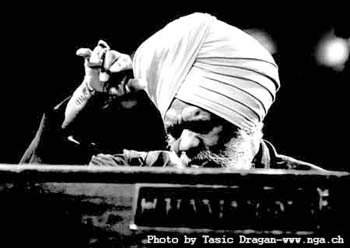
Then two days later I went to see Dr. Lonnie Smith appearing for two sets in the free entrance series of the festival, at a smaller venue. It was packed (standing room only) and they guys were "on"! The first set was rather a mess, I thought, but the second was smokin'! His fellow musicians were young Dutch guys and they did pretty well, and obviously enjoyed the company they were in! The Doctor's version of the old Beatles chestnut "Come Together" was by far the funkiest take I ever heard of that old song! Definitely a night I'll remember! (Taped it was, yes yes, of course! But not transferred yet, give me a few more days, please, and then check dime!)
The night wasn't finished just yet, as when I was to leave for home (it was midnight by then, Smith had played two sets at 70 and 90 minutes!) I was given a free entrance ticket for the closing show of this year's festival, by Cuban pianist Roberto Fonseca and his band, including woodwinds player Javier Zalba (alto & soprano sax, clarinet & flute), who was a joy to see and hear! Fonseca I got to know thanks to dime of the good zio lupo on dime, who upped the Marciac concert from August of this year, and ever since I took a vow not to miss a future Zurich appearance... I would have missed it for lack of the Swiss equivalent of eurozlotys, so I was overjoyed to get a free ticket! I stood right in front at the stage for most of the 90 minutes of a very enjoyable set. The music of Fonseca is very joyful, upbeat, mixing Cuban, Mexican (bolero), jazz, and some arab/mediterranean/andalous influences. Mostly, he's not doing the hyper-virtuoso latin-jazz stuff that I find so tiresome (think Sandoval, Chucho Valdes - not that they're bad, but they're not for me).
So that's one of the things I did in recent weeks. Another is I religiously visited as much of the on-going series of films dedicated to the late Michelangelo Antonioni at Zurich's Filmpodium.
For the first time, I had the chance to catch any of Antonioni's early films (any, besides his episode "Tentato di suicido", in L'amore in città), namely his adaption of a great story by Cesare Pavese, Le amiche, as well as Il grido, which features the first Antonionian hero (embodied by Steve Cochran). The only other early film that was part of the series, Cronaca di un amore, was on while I was still in Paris, in the first week of October.
Then I caught for the fourth and fifth time (or fifth and sixth?) both L'avventura and L'eclisse, two of the greatest films ever made, in my opinion. Monica Vitti, to me, is one of the most stunning actresses ever in these two! I missed La notte, alas, but that one I've seen several times before, too. Then I caught la Vitti again in Il deserto rosso, a film I hadn't seen before. While it doesn't nearly compare to the other three, Vitti is still fabulous - the film is taylored arund her, it seems.
Both Blow Up and Zabriskie Point I skipped this time - neither of them is nearly as good as the great ones (those being L'avventura, La notte, L'eclisse). I went to see the documentary about China, though, Chung Kuo - Cina, and it was more than just a pleasant surprise. Then this week I caught Professione: Reporter, the first film where Nicholson didn't annoy the sh*t out of me and a very beautiful film, all in all. Much, much better than I'd have expected. Also Maria Schneider is great here, much better than on the side of Brando in Last Tango in Paris, in my opinion.
Then I did catch the film Eros, with three episodes by Antonioni (crap! utter crap! embarassing! what a sorry end to his career!), Steven Soderberg (good fun, stylishly done), and Wong Kar-Wai (a treasure! actually a whole film on its own).
Now what remains is Identificazione di una donna and Al di là delle nuvole. Expectations are low... but these are rarely ever to be seen on the big screen (I still prefer that by far to TV/DVD).
Some reflections on Antonioni posted on my preferred jazz hangout:
Upon my return from my Paris visit, first thing I did was go to the movies, catching first Antonioni's Le amiche (based on a probably superior story by Cesare Pavese, though it's been a long time that I read it) - pretty good film, all in all, but some scenes were a bit... well, it does show it's age a bit, and the language of Antonioni's big films (starting with "L'avventura") isn't yet fully developped.
Then I stayed on to join mère ubu and we caught King Vidor's Duel in the Sun - now there's a ridiculously bad film for you!
of the early feature ones, plus one I missed as I was in Paris, and they also don't show that weird one - I don't know it, though - Il misterio di Oberwald or what's it called again).
Anyway, I already mentioned Le amiche - pretty good, based on a great short story by Cesare Pavese.
Then I saw Il grido, again a first for me. Seems the main character is the first truly "antonionian" "hero" (weird word... if there are any heroic characters in his films, it would have to be the women, but definitely not the men!).
I found these two rather interesting, as sort of an hors d'oeuvre for the big films to follow. Parts of the language and style of Antonioni is there, already, but it hasn't fully blossomed yet.
That first fully finished masterpiece is of course L'avventura from 1960, one of my most favourite of all films. I caught it again with mère ubu and another friend, both of whom hadn't seen it before, and gee I was astonished once again. The soundtrack is one of the most outstanding I know, the images are plain beauty... it there's something about it that hurts, it's that beauty! The beauty that lies in the loneliness, in the "not having to" (compete with social expectancies, fulfill others wishes for love, whatever).
And of course Monica Vitti is the most beautiful actress ever (ok, maybe Delphine Seyrig in Resnais' L'année dernière à Marienbad is similarly stunning in her mystery)
On my trip of (re-)discovering the films of Michelangelo Antonioni, I had the rare chance to see his documentary Chung Kuo - Cina from 1972. It is merely a documentation of what he sees, not much as far as analysis goes (admittedly so, though - he states that the Chinese are much too mysterious for him to grasp within the time and very limited access given to them, this sentence from the beginning of the film is quoted in an IMDB comment: "We have just wanted to get a picture of China, we can't offer more"). Still, it's extremely strong, as far as the images go, and the mere observation is very fascinating to see.
Also Antonioni himself does the narration in a very charming way. The images alone, of men, women, children, old and young, of industry and remote rural areas, of villages and the huge cities of Bejing and Shanghai, as well as of another old city whose name escapes me, with a dense net of canals, similar to Venice, made it a very intense experience.
There isn't much music in the film, but it has been overseen by Luciano Berio - mostly it's almost a verité approach, using chantings and some original chinese music, played - like that it sounds, at least - by small transistors and picked up by the camera microphones, just as the usual "real" sounds.
I have also caught L'eclisse yet once more. It's right up there with L'avventura, sort of a mix between a poem in film and a mathematical essai - utterly fascinating! (With some stoopid/weak/of its time moments, alas, but in the end these are needed to to make the bare-bones story work at all).
From now on, it will all be new to me: Il deserto rosso, Professione: reporter, and maybe one or two of the late ones (they skip at least one of those weird ones, the one with Vitti in it again, I think). Not sure I need to catch Zabriskie Point again... would like to see the ending again, but other than that I found it merely an ok film, not much more. Blow Up is the last really good one, to me. [EDIT: NEEDS CORRECTION! IT'S Professione: reporter!]
I'm looking forward a lot to finally catch Il deserto rosso next Saturday (and probably again Wednesday 31st), but from the ones I know, L'avventura and L'eclisse are the greatest, and they're among the greatest films ever made. La notte is a notch behind - more conventional music (albeit by Giorgio Gaslini! but the abstract music by Giovanni Fusco in the other two is a lot more fascinating).
Anyway, allow me some remarks:
General: don't get put off by the usual readings of Antonioni's films (alyways meaning this trilogy) being about "lack of communication" and "Entfremdung" (alienation? estrangement?). That way of watching these films will hopefully soon be put ad acta. The films are mainly - to me, at least - films about pretty normal stories - the beginning, frailty, end of love, about joy and sadness. There's no need to over-emphasize the "heaviness" of what the films deal with - it's nothing heavy, it's just normal life in its sad beauty and joyful sadness.
Some technical stuff, aspects that make the films as special as they are, just some lose comments (I'm no film historian, don't know the correct terminology and technical vocabulary):
Camera: angles, how if frees itself from following the main characters, goes with others in between, is playful, at times almost in a childish/naïve way. Special thing to note: the double 180 degree turn on the volcanic island, when Vitti goes outside and Ferzetti follows her, on their way back to the small hut, she almost falls, he catches her arm, camera turns twice - a very fascinating moment!
Sountrack: totally emancipated - you'll see on the part of L'avventura that's situated on that volcanic island. Sometimes you hear naturalist sounds of the waves of the ocean, mixed with voices etc, sometimes the ocean totally disappears and you hear only artificial sounds. The solo motives (clarinet, flute) that turn up are kind of haunting yet in a very abstract way.
Vitti: she's just one of the most special actresses of that time, embodying a new type of woman - independent, cool, self-conscious yet fragile, but sort of "in the know", while the men (Delon in L'eclisse and Ferzetti and a zombie-like Rabal in L'avventura) seem to struggle with themselves, seem to be sort of lost (the main character in "Il grido" is actually behaving most normal/sensible at those moments where he thinks he's totally lost it...). Anyway I guess it's Vitti who plays the main part in the exchanged roles of gender - she looks after a guy and also whistles after a police man in L'eclisse, hiding behind a tree making Delon look ridiculous... so generally, she's not just a new type, but also the traditional roles are exchanged alltogether (that applies less to L'avventura though).
Cadrage: there are tons of stunning little things to discover, like the scene in the end where you can see Ferzetti's back (dressed in a black suit) and Vitti (black dress) stretching out her (white) hand to reach for him - some stunning stuff!
And one last remark, contrary to the old (hopefully soon to be old) way of interpretating the films, there are moments of everyday luck in these films - in L'eclisse there's the flight to Verona, for instance, or the scenes depicting their love affair (but Vitti's hand hanging out of the sofa for a moment is shot in the same way as the hand of dead drunkard who stole Delon's car, when they fish the car with him inside out of the lake... you wouldn't notice such tiny details necessarily, if you didn't know about it). Anyway, in L'avventura there's that whole trip they do, searching for the missing main character (another thing that's totally beyond what had been done in mainstream cinema before, I guess it would still be impossible to do that in a big Hollywood film), where they end up in that deserted valley and later when they're at a hotel in Noto, they climb up on a campanile and start playing with the church bells - that are wonderful moments of joy, and they're to be found in the films as well.
In short, I think what makes Antonioni special is that with his films, the spectator had to grow up, or had grown up. You can't really trust what you see, but there's absolutely no need to fill that void with any heavy theories of mis-communication and alienation. The more often I see these films, the more I'm simply stunned by their beauty!
(As for Blow Up, in one of the obits I read that it was the film capturing best that "swinging London" style and mood... I don't know if that's true, but Antonioni himself was an astute observer, and that's one point going in favour of him. However, I have never found Blow Up and even less Zabriskie Point coming even remotely close to the fascination of his great masterpieces done in the earliest 1960s.)
And one most central point I forget: how Antonioni treats everyday life, how he brings small actions and things into images, in a way that it was never done before. The opening of L'eclisse is a perfect example for that. The sound of the fan that you can hear before you can see it, how the fan turns into the most lively actor in the room, while Rabal sits in his armchair like a zombie, not making the tiniest move.
And out of his treatment of things, another observation, about his treatment of architecture. Again L'eclisse is most fascinating, with the scenes shot in the stock exchange of Rome (done on location), where he kind of turns the building into a (morphing) actor itself... they keep a minute of silence (done in realtime, of course) for a deceased broker, and with just a couple of new camera positions, he establishes that most worldly of buildings as a sacral church-like room. Very, very fascinating!
And all of that is done with an ease and lightness that betrays the huge amount of work that must have been done behind the scenes.
Will catch Antonioni's Il deserto rosso a second time tonight (already saw it on Saturday, for the very first time) [EDIT: I DID NOT, ALAS!].
Definitely the most dated of the four great films of his, but Vitti alone is stunning! Sort of the contrary to Cassavetes/Rowlands' "A Woman Under the Influence", on the extreme quiet side, with madness as a shock and unableness to act, rather than the artificial extreme business of Rowlands'.
And there's yet another great Fusco score, and the colours of the film (all pastels) are fascinating, too.
It's a big parable, in the end - madness isn't the diagnosis for Vitti, rather it's the diagnosis for the whole society, while she who is said to be crazy, is actually the sane, sensitive person. That kind of story wouldn't be told today, and if it would, it would never be done in such a total way... even more so that makes it a fascinating film, extremely suggestive!
In between I also caught Preston Sturges' dear film The Lady Eve, with Barbara Stanwyck outdoing herself!
*****
I did catch some nice musicians at this year's jazznojazz festival in Zurich, though.
First I saw Susanne Abbuehl and her band with guest Michel Portal (I taped this and put it up on dime). The music was, well... as Susanne said during her Umea concert (October 2006, I got it off dime) she does "rubato music", and to be honest, it doesn't work that well in a live setting, even less so in such a big hall (the EWZ in Zurich, a used-to-be factory building). Anyway, she has a great, warm voice, and her band is very sympathetic: Christof May on clarinets and Wolfert Brederode on piano and harmonium have been with her for fifteen years now, and the new face, Lucas Niggli, has taken Samuel Rohrer's chair on drums and percussion - he provided many highlights, bringing in a bit of live and a bit of fun to the whole proceedings. I was all the more surprised then, how much I liked the music when I played it again at home the next night - beautiful music that simply doesn't work half as good on stage than it does work at home... guest Michel Portal was great to see, however, doing some fantastic solos and stuff (I used to play some clarinet, too, eons ago, so this was really fun)!
Then two days later I went to see Dr. Lonnie Smith appearing for two sets in the free entrance series of the festival, at a smaller venue. It was packed (standing room only) and they guys were "on"! The first set was rather a mess, I thought, but the second was smokin'! His fellow musicians were young Dutch guys and they did pretty well, and obviously enjoyed the company they were in! The Doctor's version of the old Beatles chestnut "Come Together" was by far the funkiest take I ever heard of that old song! Definitely a night I'll remember! (Taped it was, yes yes, of course! But not transferred yet, give me a few more days, please, and then check dime!)
The night wasn't finished just yet, as when I was to leave for home (it was midnight by then, Smith had played two sets at 70 and 90 minutes!) I was given a free entrance ticket for the closing show of this year's festival, by Cuban pianist Roberto Fonseca and his band, including woodwinds player Javier Zalba (alto & soprano sax, clarinet & flute), who was a joy to see and hear! Fonseca I got to know thanks to dime of the good zio lupo on dime, who upped the Marciac concert from August of this year, and ever since I took a vow not to miss a future Zurich appearance... I would have missed it for lack of the Swiss equivalent of eurozlotys, so I was overjoyed to get a free ticket! I stood right in front at the stage for most of the 90 minutes of a very enjoyable set. The music of Fonseca is very joyful, upbeat, mixing Cuban, Mexican (bolero), jazz, and some arab/mediterranean/andalous influences. Mostly, he's not doing the hyper-virtuoso latin-jazz stuff that I find so tiresome (think Sandoval, Chucho Valdes - not that they're bad, but they're not for me).
*****
So that's one of the things I did in recent weeks. Another is I religiously visited as much of the on-going series of films dedicated to the late Michelangelo Antonioni at Zurich's Filmpodium.
For the first time, I had the chance to catch any of Antonioni's early films (any, besides his episode "Tentato di suicido", in L'amore in città), namely his adaption of a great story by Cesare Pavese, Le amiche, as well as Il grido, which features the first Antonionian hero (embodied by Steve Cochran). The only other early film that was part of the series, Cronaca di un amore, was on while I was still in Paris, in the first week of October.
Then I caught for the fourth and fifth time (or fifth and sixth?) both L'avventura and L'eclisse, two of the greatest films ever made, in my opinion. Monica Vitti, to me, is one of the most stunning actresses ever in these two! I missed La notte, alas, but that one I've seen several times before, too. Then I caught la Vitti again in Il deserto rosso, a film I hadn't seen before. While it doesn't nearly compare to the other three, Vitti is still fabulous - the film is taylored arund her, it seems.
Both Blow Up and Zabriskie Point I skipped this time - neither of them is nearly as good as the great ones (those being L'avventura, La notte, L'eclisse). I went to see the documentary about China, though, Chung Kuo - Cina, and it was more than just a pleasant surprise. Then this week I caught Professione: Reporter, the first film where Nicholson didn't annoy the sh*t out of me and a very beautiful film, all in all. Much, much better than I'd have expected. Also Maria Schneider is great here, much better than on the side of Brando in Last Tango in Paris, in my opinion.
Then I did catch the film Eros, with three episodes by Antonioni (crap! utter crap! embarassing! what a sorry end to his career!), Steven Soderberg (good fun, stylishly done), and Wong Kar-Wai (a treasure! actually a whole film on its own).
Now what remains is Identificazione di una donna and Al di là delle nuvole. Expectations are low... but these are rarely ever to be seen on the big screen (I still prefer that by far to TV/DVD).
Some reflections on Antonioni posted on my preferred jazz hangout:
***
Upon my return from my Paris visit, first thing I did was go to the movies, catching first Antonioni's Le amiche (based on a probably superior story by Cesare Pavese, though it's been a long time that I read it) - pretty good film, all in all, but some scenes were a bit... well, it does show it's age a bit, and the language of Antonioni's big films (starting with "L'avventura") isn't yet fully developped.
Then I stayed on to join mère ubu and we caught King Vidor's Duel in the Sun - now there's a ridiculously bad film for you!
*
of the early feature ones, plus one I missed as I was in Paris, and they also don't show that weird one - I don't know it, though - Il misterio di Oberwald or what's it called again).
Anyway, I already mentioned Le amiche - pretty good, based on a great short story by Cesare Pavese.
Then I saw Il grido, again a first for me. Seems the main character is the first truly "antonionian" "hero" (weird word... if there are any heroic characters in his films, it would have to be the women, but definitely not the men!).
I found these two rather interesting, as sort of an hors d'oeuvre for the big films to follow. Parts of the language and style of Antonioni is there, already, but it hasn't fully blossomed yet.
That first fully finished masterpiece is of course L'avventura from 1960, one of my most favourite of all films. I caught it again with mère ubu and another friend, both of whom hadn't seen it before, and gee I was astonished once again. The soundtrack is one of the most outstanding I know, the images are plain beauty... it there's something about it that hurts, it's that beauty! The beauty that lies in the loneliness, in the "not having to" (compete with social expectancies, fulfill others wishes for love, whatever).
And of course Monica Vitti is the most beautiful actress ever (ok, maybe Delphine Seyrig in Resnais' L'année dernière à Marienbad is similarly stunning in her mystery)
*
On my trip of (re-)discovering the films of Michelangelo Antonioni, I had the rare chance to see his documentary Chung Kuo - Cina from 1972. It is merely a documentation of what he sees, not much as far as analysis goes (admittedly so, though - he states that the Chinese are much too mysterious for him to grasp within the time and very limited access given to them, this sentence from the beginning of the film is quoted in an IMDB comment: "We have just wanted to get a picture of China, we can't offer more"). Still, it's extremely strong, as far as the images go, and the mere observation is very fascinating to see.
Also Antonioni himself does the narration in a very charming way. The images alone, of men, women, children, old and young, of industry and remote rural areas, of villages and the huge cities of Bejing and Shanghai, as well as of another old city whose name escapes me, with a dense net of canals, similar to Venice, made it a very intense experience.
There isn't much music in the film, but it has been overseen by Luciano Berio - mostly it's almost a verité approach, using chantings and some original chinese music, played - like that it sounds, at least - by small transistors and picked up by the camera microphones, just as the usual "real" sounds.
I have also caught L'eclisse yet once more. It's right up there with L'avventura, sort of a mix between a poem in film and a mathematical essai - utterly fascinating! (With some stoopid/weak/of its time moments, alas, but in the end these are needed to to make the bare-bones story work at all).
From now on, it will all be new to me: Il deserto rosso, Professione: reporter, and maybe one or two of the late ones (they skip at least one of those weird ones, the one with Vitti in it again, I think). Not sure I need to catch Zabriskie Point again... would like to see the ending again, but other than that I found it merely an ok film, not much more. Blow Up is the last really good one, to me. [EDIT: NEEDS CORRECTION! IT'S Professione: reporter!]
*
I'm looking forward a lot to finally catch Il deserto rosso next Saturday (and probably again Wednesday 31st), but from the ones I know, L'avventura and L'eclisse are the greatest, and they're among the greatest films ever made. La notte is a notch behind - more conventional music (albeit by Giorgio Gaslini! but the abstract music by Giovanni Fusco in the other two is a lot more fascinating).
Anyway, allow me some remarks:
General: don't get put off by the usual readings of Antonioni's films (alyways meaning this trilogy) being about "lack of communication" and "Entfremdung" (alienation? estrangement?). That way of watching these films will hopefully soon be put ad acta. The films are mainly - to me, at least - films about pretty normal stories - the beginning, frailty, end of love, about joy and sadness. There's no need to over-emphasize the "heaviness" of what the films deal with - it's nothing heavy, it's just normal life in its sad beauty and joyful sadness.
Some technical stuff, aspects that make the films as special as they are, just some lose comments (I'm no film historian, don't know the correct terminology and technical vocabulary):
Camera: angles, how if frees itself from following the main characters, goes with others in between, is playful, at times almost in a childish/naïve way. Special thing to note: the double 180 degree turn on the volcanic island, when Vitti goes outside and Ferzetti follows her, on their way back to the small hut, she almost falls, he catches her arm, camera turns twice - a very fascinating moment!
Sountrack: totally emancipated - you'll see on the part of L'avventura that's situated on that volcanic island. Sometimes you hear naturalist sounds of the waves of the ocean, mixed with voices etc, sometimes the ocean totally disappears and you hear only artificial sounds. The solo motives (clarinet, flute) that turn up are kind of haunting yet in a very abstract way.
Vitti: she's just one of the most special actresses of that time, embodying a new type of woman - independent, cool, self-conscious yet fragile, but sort of "in the know", while the men (Delon in L'eclisse and Ferzetti and a zombie-like Rabal in L'avventura) seem to struggle with themselves, seem to be sort of lost (the main character in "Il grido" is actually behaving most normal/sensible at those moments where he thinks he's totally lost it...). Anyway I guess it's Vitti who plays the main part in the exchanged roles of gender - she looks after a guy and also whistles after a police man in L'eclisse, hiding behind a tree making Delon look ridiculous... so generally, she's not just a new type, but also the traditional roles are exchanged alltogether (that applies less to L'avventura though).
Cadrage: there are tons of stunning little things to discover, like the scene in the end where you can see Ferzetti's back (dressed in a black suit) and Vitti (black dress) stretching out her (white) hand to reach for him - some stunning stuff!
And one last remark, contrary to the old (hopefully soon to be old) way of interpretating the films, there are moments of everyday luck in these films - in L'eclisse there's the flight to Verona, for instance, or the scenes depicting their love affair (but Vitti's hand hanging out of the sofa for a moment is shot in the same way as the hand of dead drunkard who stole Delon's car, when they fish the car with him inside out of the lake... you wouldn't notice such tiny details necessarily, if you didn't know about it). Anyway, in L'avventura there's that whole trip they do, searching for the missing main character (another thing that's totally beyond what had been done in mainstream cinema before, I guess it would still be impossible to do that in a big Hollywood film), where they end up in that deserted valley and later when they're at a hotel in Noto, they climb up on a campanile and start playing with the church bells - that are wonderful moments of joy, and they're to be found in the films as well.
In short, I think what makes Antonioni special is that with his films, the spectator had to grow up, or had grown up. You can't really trust what you see, but there's absolutely no need to fill that void with any heavy theories of mis-communication and alienation. The more often I see these films, the more I'm simply stunned by their beauty!
(As for Blow Up, in one of the obits I read that it was the film capturing best that "swinging London" style and mood... I don't know if that's true, but Antonioni himself was an astute observer, and that's one point going in favour of him. However, I have never found Blow Up and even less Zabriskie Point coming even remotely close to the fascination of his great masterpieces done in the earliest 1960s.)
*
And one most central point I forget: how Antonioni treats everyday life, how he brings small actions and things into images, in a way that it was never done before. The opening of L'eclisse is a perfect example for that. The sound of the fan that you can hear before you can see it, how the fan turns into the most lively actor in the room, while Rabal sits in his armchair like a zombie, not making the tiniest move.
And out of his treatment of things, another observation, about his treatment of architecture. Again L'eclisse is most fascinating, with the scenes shot in the stock exchange of Rome (done on location), where he kind of turns the building into a (morphing) actor itself... they keep a minute of silence (done in realtime, of course) for a deceased broker, and with just a couple of new camera positions, he establishes that most worldly of buildings as a sacral church-like room. Very, very fascinating!
And all of that is done with an ease and lightness that betrays the huge amount of work that must have been done behind the scenes.
*
Will catch Antonioni's Il deserto rosso a second time tonight (already saw it on Saturday, for the very first time) [EDIT: I DID NOT, ALAS!].
Definitely the most dated of the four great films of his, but Vitti alone is stunning! Sort of the contrary to Cassavetes/Rowlands' "A Woman Under the Influence", on the extreme quiet side, with madness as a shock and unableness to act, rather than the artificial extreme business of Rowlands'.
And there's yet another great Fusco score, and the colours of the film (all pastels) are fascinating, too.
It's a big parable, in the end - madness isn't the diagnosis for Vitti, rather it's the diagnosis for the whole society, while she who is said to be crazy, is actually the sane, sensitive person. That kind of story wouldn't be told today, and if it would, it would never be done in such a total way... even more so that makes it a fascinating film, extremely suggestive!
***
In between I also caught Preston Sturges' dear film The Lady Eve, with Barbara Stanwyck outdoing herself!
*****
Alright then, I guess no one's still reading by now, so I'll wind it up with a couple of short remarks:
My edit of a recent Mike Gibbs seed on dime (Southampton 1983 - fantastic show):
http://www.dimeadozen.org/torrents-details.php?id=168731
My fixed re-seed of a great Ellington show on dime:
http://www.dimeadozen.org/torrents-details.php?id=166945
And then to end, here's a promise for some new stuff to be uploaded here sometime soon (meaning: a week or two - doesn't work faster, I'm sorry! Still need to cut some stuff - all unreleased/radio material!)
Alright then, I guess no one's still reading by now, so I'll wind it up with a couple of short remarks:
My edit of a recent Mike Gibbs seed on dime (Southampton 1983 - fantastic show):
http://www.dimeadozen.org/torrents-details.php?id=168731
My fixed re-seed of a great Ellington show on dime:
http://www.dimeadozen.org/torrents-details.php?id=166945
*****
And then to end, here's a promise for some new stuff to be uploaded here sometime soon (meaning: a week or two - doesn't work faster, I'm sorry! Still need to cut some stuff - all unreleased/radio material!)
Saturday, September 01, 2007
Jan Brönnimann's "Brinkmanship" feat. Nils-Petter Molvaer - Willisau 2007 - now on dime

I've been neglecting the blog now for quite a while - apologies for that. There have been a couple of things that needed to be done in real life, and honestly I'm not quite sure what the future of my blog is... anyway, after a little while, here's a new upload on dime to announce, at least - last night's concert of Jan Brönnimann's "Brinkmanship" with special guest Nils-Petter Molvaer. Spacious ambient jazz with lots of quiet lyrical passages but lots of good grooves, too - I enjoy this band quite a bit, and the addition of Molvaer doesn't do any harm, for sure!
**********************************************************
Jan Brönnimann's Brinkmanship feat. Nils-Petter Molvaer
Willisau (Switzerland), Jazzfestival
Next Waves I
August 31, 2007
Jan-Petter Molvaer - trumpet, electronics
Jan "Galega" Brönnimann - saxophones, clarinets, electronics
René Reimann - guitar
Emanuel Schnyder - electric bass, double bass
Christoph Staudenmann - drums, samples
Nya - vocals, electronics
*** complete concert ***
CD1/47:29
1. 1937 > Aussenbezirk > String Remix > Ann JB (47:29)
CD2/47:00
1. Signpost > Ann JB (26:08) [splice @ 24:10.5]
2. Silberfisch (11:41)
3. unknown (9:09)
TT: 94:29
Sound: A/A- (mono)
Source (CD1,CD2#1 to splice): DRS 2 broadcast / 2007-08-31 - 2007-09-01 (after the concert)
Source (CD2#1 from splice to end): RSI 2 broadcast / 2007-08-31 (live)
Lineage: FM > HD > Cool Edit Pro > FLAC (8,asb,verify)
Note: RSI 2 started their live broadcast early in CD2#1 (around 5-6 minutes were missing) and went on to the end of the concert, while DRS 2 broadcast a large part of this long concert after their live broadcast of the second set of the day. The parts broadcast by DRS 2 were the opening parts of the Brinkmanship set, as the announcer said, and included CD1 and CD2#2 minus applause/announcement.
Thursday, August 23, 2007
Duke & Ella
no one from the dimers who dowloaded my Anita and Tete sets seem to have found their way over here to grab the third set I have from Antibes 1966, so here's a post dedicated to this one in the open, as opposed to the "easter egg", as which it had been disguised before...
I assume all or most of this is on the big 8CD box of Duke & Ella in Antibes - too much of a good thing for me - I love Duke and own the RCA set, the Capitol and Reprise Mosaics, the recent Storyville box, the Private Collection, the Carnegie Hall Concerts, and a whole bunch of single CD reissues, too, from Columbia, Bethlehem, Blue Note, Impulse etc. - but I'm not that big an Ella fan... and 1966 was past the Duke's prime, too...
Anyway, this short set, radio-sourced, is certainly nice to have! Links in the comments, all info included with the DL.
I assume all or most of this is on the big 8CD box of Duke & Ella in Antibes - too much of a good thing for me - I love Duke and own the RCA set, the Capitol and Reprise Mosaics, the recent Storyville box, the Private Collection, the Carnegie Hall Concerts, and a whole bunch of single CD reissues, too, from Columbia, Bethlehem, Blue Note, Impulse etc. - but I'm not that big an Ella fan... and 1966 was past the Duke's prime, too...
Anyway, this short set, radio-sourced, is certainly nice to have! Links in the comments, all info included with the DL.
Saturday, August 18, 2007
Töbi Tobler - Altdorf 2007 - now on dime
Here's one fresh off the press - yesterday's solo recital at the great Alpentöne festival in Altdorf by Töbi Tobler on Hackbrett (hammered dulcimer). Quite a nice surprise! I like this honest and simple kind of folk music - though his horizon is much broader and he incorporates some of it in his music, too. Anyway, folk music shouldn't just be conserved as is, rather it should evolve, and here's a fine example for that!

**********************************************************
Töbi Tobler Solo
Alpentöne 2007
Altdorf (Switzerland), Schlüsselsaal
August 17, 2007
Töbi Tobler - Hackbrett & voice
1. Introduction TT (0:38)
2. Medley / Improvisation (22:09)
3. Zäuerli (9:02)
4. Heurigentanz (9:22)
5. Family Goes Shopping (3:13)
6. unknown (Schluss / Ending) (8:15)
7. [encore] (3:18)
8. Interview (by Kjell Keller) (6:30)
TT: 62:30
Sound: A- (mono)
Source: DRS 2 "Weltklasse auf DRS 2" / 2007-08-17 (live)
Lineage: FM > HD > Cool Edit Pro > FLAC (8,asb,verify)
Note: much of this music is improvised, partly it's based on traditional melodies/songs, partly on Tobler's own tunes. The encore possibly is an old Swiss folk song, but I'm not quite so familiar with that kind of music... traditional folk music (not of the commercialised crap kind marketed on German/Austrian/Swiss TV) lies at the core of this music, though, paired with Tobler's experience as a drummer with various well-known Swiss musicians, as well as his own band, "Appezeller Space Schöttl".

**********************************************************
Töbi Tobler Solo
Alpentöne 2007
Altdorf (Switzerland), Schlüsselsaal
August 17, 2007
Töbi Tobler - Hackbrett & voice
1. Introduction TT (0:38)
2. Medley / Improvisation (22:09)
3. Zäuerli (9:02)
4. Heurigentanz (9:22)
5. Family Goes Shopping (3:13)
6. unknown (Schluss / Ending) (8:15)
7. [encore] (3:18)
8. Interview (by Kjell Keller) (6:30)
TT: 62:30
Sound: A- (mono)
Source: DRS 2 "Weltklasse auf DRS 2" / 2007-08-17 (live)
Lineage: FM > HD > Cool Edit Pro > FLAC (8,asb,verify)
Note: much of this music is improvised, partly it's based on traditional melodies/songs, partly on Tobler's own tunes. The encore possibly is an old Swiss folk song, but I'm not quite so familiar with that kind of music... traditional folk music (not of the commercialised crap kind marketed on German/Austrian/Swiss TV) lies at the core of this music, though, paired with Tobler's experience as a drummer with various well-known Swiss musicians, as well as his own band, "Appezeller Space Schöttl".
Friday, August 17, 2007
ubu's Max Roach Memorial listen

Max Roach, Dizzy Gillespie, Charlie Parker
Here are some impressions about the tough but rewarding ride I just finished... (relaxin' with Sonny Stitt's "Deuces Wild" now, a gift I just got from a friend).
Thanks a lot, Max, for all the great music!
I started with Percussion Bitter Suite (covered in the previous Roach post), then went on with the following albums:
It's Time (Impulse!, 1962) - one of the best of those chorus albums. Max stands out here, his playing is so poised - awesome! Jordan has many fine spots and so has Richard Williams - too bad he wasn't getting more exposure, a very fine musician in any context I've heard him in (Jones/Lewis big band, Gigi Gryce, Mingus, his sole leader album on Candid, Lateef...)
Speak, Brother, Speak! (Fantasy/OJC, 1962) - Much better than most reviews want us to think! Jordan is on fire, Waldron does his long meandering lines. And Eddie Khan holds his own with a much earthier sound and delivery than Art Davis, more a felt bass player, but very much there, all of the time! And again Roach is doing great! This is a fairly simple, blowing album (though the two long numbers, or at least the first 25 minute long title track, are some kind of suites with various parts in changing tempos), other than the music preceeding it - the last Mercury albums, the Candid and the two Impulses all had larger line-ups and/or more thorough concepts and arrangements. Here they just blow, and it's good to hear them doing that! And the music is earthy and soulful, and yes, it swings!
The Max Roach Trio Featuring the Legendary Hasaan (Atlantic, 1964) - a weird one... all the hype about that Hasaan chap is more hot air than anything - not really a huge loss that he remained legendary... however, he's a fun pianist to listen to, there's no denying that! The main point of interest here though, is Roach's highly creative drumming and Art Davis' bass providing a great bottom for the music - their playing together is simply terrific here!
Drums Unlimited (Atlantic, 1965/66) - Very nice one! The short solos are terrific, and the groove hit by Jymie Merritt and Ronnie Mathews (he sounds a lot like Bobby Timmons here) on "Nommo" is terrific! Freddie Hubbard is at his aggressive best - I quite like him as a sideman on most album's I've heard him (he appears on so many important albums!), while I don't like his leader dates that much... or I rather listen to them for the bands, not for him. Anyway, he's serious here! There's also the live date from the band's tour in late '66 where Hubbard asks the (white, of course) audience in Graz, Austria, to kiss his black ass... I'll have to play that again soon!
Lift Every Voice and Sing (Atlantic, 1971)- A collection of spirituals (except for #2 by one Patricia Curtis and Max Roach), arranged for choir and the Roach group, at that stage (1971) including Cecil Bridgewater and the great Billy Harper who does some apeshit soloing here - great! George Cables is on electric piano. I like this one a lot. It's more of its time and less a great piece of art than "It's Time", I think, but it has a lot going on, there's a certain aggressiveness in the music that reaches out and grabs me!
Now playing Members, Don't Git Weary (Atlantic, 1969) - and guess what, this (and also Lift Every Voice) is where for me - unintentionally - the focus while listening shifts away more and more from Max, towards the other musicians. Tolliver is great, Bartz also contributes a few nice solos (and his composition "Libra"), and Stanley Cowell is great to have on any album from that period... I'd have preferred Merritt on double bass, though... his sound on "Nommo" (Drums Unlimited) is so fat and boomy, he'd have had a better groove than on electric bass... and about Roach, I guess this is where he kind of started losing his great, aggressive, individual style of drumming (now this is crap, put in such general words, I know...) ... now this doesn't mean "Members" is a bad album, not even a mediocre one, there's plenty of good music on it, but Max' own playing ain't quite so exciting any longer... (even though - I doubt I could, though - some may hear it's Max within one bar from any of the tunes...)
Addition: Merritt is partly on double bass (for instance on the title track) - but I'd wished he'd be on it on the funky opening number, for instance!
Max Roach (1924-2007)

Maxwell Roach, January 10, 1924 - August 16, 2007
Some background reading on the era and the civil rights movement:
http://memory.loc.gov/ammem/aaohtml/aopart9.html
:: New York Times obituary ::
August 16, 2007
Max Roach, a Founder of Modern Jazz, Dies at 83
By PETER KEEPNEWS
Max Roach, a founder of modern jazz who rewrote the rules of drumming in the 1940’s and spent the rest of his career breaking musical barriers and defying listeners’ expectations, died early today at his home in New York. He was 83.
His death was announced today by a spokesman for Blue Note records, on which he frequently appeared. No cause was given. Mr. Roach had been known to be ill for several years.
As a young man, Mr. Roach, a percussion virtuoso capable of playing at the most brutal tempos with subtlety as well as power, was among a small circle of adventurous musicians who brought about wholesale changes in jazz. He remained adventurous to the end.
Over the years he challenged both his audiences and himself by working not just with standard jazz instrumentation, and not just in traditional jazz venues, but in a wide variety of contexts, some of them well beyond the confines of jazz as that word is generally understood.
He led a “double quartet” consisting of his working group of trumpet, saxophone, bass and drums plus a string quartet. He led an ensemble consisting entirely of percussionists. He dueted with uncompromising avant-gardists like the pianist Cecil Taylor and the saxophonist Anthony Braxton. He performed unaccompanied. He wrote music for plays by Sam Shepard and dance pieces by Alvin Ailey. He collaborated with video artists, gospel choirs and hip-hop performers.
Mr. Roach explained his philosophy to The New York Times in 1990: “You can’t write the same book twice. Though I’ve been in historic musical situations, I can’t go back and do that again. And though I run into artistic crises, they keep my life interesting.”
He found himself in historic situations from the beginning of his career. He was still in his teens when he played drums with the alto saxophonist Charlie Parker, a pioneer of modern jazz, at a Harlem after-hours club in 1942. Within a few years, Mr. Roach was himself recognized as a pioneer in the development of the sophisticated new form of jazz that came to be known as bebop.
He was not the first drummer to play bebop — Kenny Clarke, 10 years his senior, is generally credited with that distinction — but he quickly established himself as both the most imaginative percussionist in modern jazz and the most influential.
In Mr. Roach’s hands, the drum kit became much more than a means of keeping time. He saw himself as a full-fledged member of the front line, not simply as a supporting player.
Layering rhythms on top of rhythms, he paid as much attention to a song’s melody as to its beat. He developed, as the jazz critic Burt Korall put it, “a highly responsive, contrapuntal style,” engaging his fellow musicians in an open-ended conversation while maintaining a rock-solid pulse. His approach “initially mystified and thoroughly challenged other drummers,” Mr. Korall wrote, but quickly earned the respect of his peers and established a new standard for the instrument.
Mr. Roach was an innovator in other ways. In the late 1950s, he led a group that was among the first in jazz to regularly perform pieces in waltz time and other unusual meters in addition to the conventional 4/4. In the early 1960s, he was among the first to use jazz to address racial and political issues, with works like the album-length “We Insist! Freedom Now Suite.”
In 1972, he became one of the first jazz musicians to teach full time at the college level when he was hired as a professor at the University of Massachusetts at Amherst. And in 1988, he became the first jazz musician to receive a so-called genius grant from the MacArthur Foundation.
Maxwell Roach was born on Jan. 10, 1924, in the small town of New Land, N.C., and grew up in the Bedford-Stuyvesant section of Brooklyn. He began studying piano at a neighborhood Baptist church when he was 8 and took up the drums a few years later.
Even before he graduated from Boys High School in 1942, savvy New York jazz musicians knew his name. As a teenager he worked briefly with Duke Ellington’s orchestra at the Paramount Theater and with Charlie Parker at Monroe’s Uptown House in Harlem, where he took part in jam sessions that helped lay the groundwork for bebop.
By the middle 1940’s, he had become a ubiquitous presence on the New York jazz scene, working in the 52nd Street nightclubs with Parker, the trumpeter Dizzy Gillespie and other leading modernists. Within a few years he had become equally ubiquitous on record, participating in such seminal recordings as Miles Davis’s “Birth of the Cool” sessions in 1949 and 1950.
He also found time to study composition at the Manhattan School of Music. He had planned to major in percussion, he later recalled in an interview, but changed his mind after a teacher told him his technique was incorrect. “The way he wanted me to play would have been fine if I’d been after a career in a symphony orchestra,” he said, “but it wouldn’t have worked on 52nd Street.”
Mr. Roach made the transition from sideman to leader in 1954, when he and the young trumpet virtuoso Clifford Brown formed a quintet. That group, which specialized in a muscular and stripped-down version of bebop that came to be called hard bop, took the jazz world by storm. But it was short-lived.
In June 1956, at the height of the Brown-Roach quintet’s success, Brown was killed in an automobile accident, along with Richie Powell, the group’s pianist, and Powell’s wife. The sudden loss of his friend and co-leader, Mr. Roach later recalled, plunged him into depression and heavy drinking from which it took him years to emerge.
Nonetheless, he kept working. He honored his existing nightclub bookings with the two surviving members of his group, the saxophonist Sonny Rollins and the bassist George Morrow, before briefly taking time off and putting together a new quartet. By the end of the 50’s, seemingly recovered from his depression, he was recording prolifically, mostly as a leader but occasionally as a sideman with Mr. Rollins and others.
The personnel of Mr. Roach’s working group changed frequently over the next decade, but the level of artistry and innovation remained high. His sidemen included such important musicians as the saxophonists Eric Dolphy, Stanley Turrentine and George Coleman and the trumpet players Donald Byrd, Kenny Dorham and Booker Little. Few of his groups had a pianist, making for a distinctively open ensemble sound in which Mr. Roach’s drums were prominent.
Always among the most politically active of jazz musicians, Mr. Roach had helped the bassist Charles Mingus establish one of the first musician-run record companies, Debut, in 1952. Eight years later, the two organized a so-called rebel festival in Newport, R.I., to protest the Newport Jazz Festival’s treatment of performers. That same year, Mr. Roach collaborated with the lyricist Oscar Brown Jr. on “We Insist! Freedom Now Suite,” which played variations on the theme of black people’s struggle for equality in the United States and Africa.
The album, which featured vocals by Abbey Lincoln (Mr. Roach’s frequent collaborator and, from 1962 to 1970, his wife), received mixed reviews: many critics praised its ambition, but some attacked it as overly polemical. Mr. Roach was undeterred.
“I will never again play anything that does not have social significance,” he told Down Beat magazine after the album’s release. “We American jazz musicians of African descent have proved beyond all doubt that we’re master musicians of our instruments. Now what we have to do is employ our skill to tell the dramatic story of our people and what we’ve been through.”
“We Insist!” was not a commercial success, but it emboldened Mr. Roach to broaden his scope as a composer. Soon he was collaborating with choreographers, filmmakers and Off Broadway playwrights on projects, including a stage version of “We Insist!”
As his range of activities expanded, his career as a bandleader became less of a priority. At the same time, the market for his uncompromising brand of small-group jazz began to diminish. By the time he joined the faculty of the University of Massachusetts in 1972, teaching had come to seem an increasingly attractive alternative to the demands of the musician’s life.
Joining the academy did not mean turning his back entirely on performing. In the early ‘70s, Mr. Roach joined with seven fellow drummers to form M’Boom, an ensemble that achieved tonal and coloristic variety through the use of xylophones, chimes, steel drums and other percussion instruments. Later in the decade he formed a new quartet, two of whose members — the saxophonist Odean Pope and the trumpeter Cecil Bridgewater — would perform and record with him off and on for more than two decades.
He also participated in a number of unusual experiments. He appeared in concert in 1983 with a rapper, two disc jockeys and a team of break dancers. A year later, he composed music for an Off Broadway production of three Sam Shepard plays, for which he won an Obie Award. In 1985, he took part in a multimedia collaboration with the video artist Kit Fitzgerald and the stage director George Ferencz.
Perhaps his most ambitious experiment in those years was the Max Roach Double Quartet, a combination of his quartet and the Uptown String Quartet. Jazz musicians had performed with string accompaniment before, but rarely if ever in a setting like this, where the string players were an equal part of the ensemble and were given the opportunity to improvise. Reviewing a Double Quartet album in The Times in 1985, Robert Palmer wrote, “For the first time in the history of jazz recording, strings swing as persuasively as any saxophonist or drummer.”
This endeavor had personal as well as musical significance for Mr. Roach: the Uptown String Quartet’s founder and viola player was his daughter Maxine. She survives him, as do two other daughters, Ayo and Dara, and two sons, Raoul and Darryl.
By the early ‘90s, Mr. Roach had reduced his teaching load and was again based in New York year-round, traveling to Amherst only for two residencies and a summer program each year. He was still touring with his quartet as recently as 2000, and he also remained active as a composer. In 2002 he wrote and performed the music for “How to Draw a Bunny,” a documentary about the artist Ray Johnson.
:: ubu's notes ::
These are copy-pasted from several threads over on Organissimo.
I've been digging a lot of Max Roach's music, lately. Put most of the Clifford Brown/Max Roach Quintet material from the great 10CD box onto my iPod (omitting some alternates and false starts). Then I just recently got around playing most of the Mosaic box, combined with the albums he did for other labels in between the Mercury albums, including Max (Argo), Deeds Not Words (Riverside), the Time album, Award Winning Drummer, and just this morning while commuting the great Prestige album of Sonny Rollins' heading the Roach +4 band (Sonny Rollins Plays For Bird) with Wade Legge and Kenny Dorham (including the magnificient Bird-medley, which probably was the idea for the Mercury album Max Roach Plays Charlie Parker, I assume?). Later I also played the Booker Little 4+ Max Roach album (United Artists/Blue Note CD).
The earlier Mercury albums on the Mosaic, Max Roach +4, Jazz in 3/4 Time (this one's easily available on CD, the only one besides the Jazz in Paris edition of "Parisian Sketches" that is, from the Mercury output), Max Roach 4 Plays Charlie Parker, Max Roach +4 on the Chicago Scene, fit right in with the Argo, Riverside and Time album. The last of the Mercury albums before the Turrentines arrived to replace the Booker Little/George Coleman frontline, The Many Sides of Max, is a minor masterpiece.
Anyway, it's most fascinating to see how Max evolves.
Also it's very interesting to read the liners in the Mosaic and compare the music, play it in chronological way, check out how Roach's solo conception changes and grows... he seems to have been one of jazz' sharpest minds back then - a very intriguing character, to me.
Looking forward now to continue the trip with more of the Turrentine Bros./Julian Priester Quintet (incl. Tommy Turrentine's self-titled album for Time adding Horace Parlan on piano, and the live album on Enja, Long As You're Living predating the last of the Mercury albums recorded in Paris). Next then what I still think are his best albums (besides the Brown/Roach material), Freedom Now Suite and Percussion Bitter Suite.
What a great body of work in so few years! Too bad only that Mercury had more of a project-based approach and didn't document the working quartets/quintets more thoroughly! They're clearly on fire on the 1958 Newport (Mercury) set!
*****
Max' huge contribution to Sonny Rollins' Saxophone Colossus - that's the first album I ever heard with him on drums. The solo he pulls on "St. Thomas" is jaw-dropping (as is the whole album... Blue Seven!)
Beautiful sound on that album too (even on the 80s Fantasy version), it's so deep and blue - one of my very favourite albums to this day!
I was able to catch Max live, in a weird concert with Abdullah Ibrahim. First both of them played half a solo set, and after the break they made a lame attempt at a duo. The Roach solo portion was the only part that was convincing and partly very good, but the whole event was a big letdown, even though I love both guys when they're on their own (or working with more sympathetic partners).
To The Max, the 2CD set, is a nice showcase of more recent Roach, including M'Boom, his 80s quartet, the double quartet and more. Covers all the variety of things Max did in his later career.
Nothing of it comes close, in my opinion, to the stuff he did in 55-63 or so, though... in fact probably most of his post Brownie material isn't coming close to their quintet in 55/56, except maybe for the Candid and Impulse albums mentioned in my first post.
But then, luckily, it's not just about "greatest" albums all the time... he did so many good and great ones besides those classics, too!
*****
Art Davis (December 5, 1934 - July 29, 2007)
I have been playing the Roach Mosaic set with additional other discs in between and have just entered the tuba band months... Davis was a monster player! His playing on the Newport live set (with a broken index finger) is terrific!
He always struck me as a terrific musician when playing with Roach - and as "just" a very good bass player in most of the other contexts I've heard him in. Magic at work when he and Roach got together!
Probably he was just too strong a musical personality. I mean his walking lines, his timing, all of it is too personal for him to just fit in on any kind of jam session or loosely arranged studio date. With Roach though, he's very inspired and inspiring, I find - much more so than George Morrow, who just happens to play the bass in the band, most of the time, Davis is there, you can feel him at any given moment and he's actively shaping the music, not just accompanying - that's how it feels to me, at least...
... is that there are statements about George Morrow in the montage of quotes by musicians/sideman in the Roach Mosaic booklet, that state that he was the only one to really cope with the fast tempos at that time (before Davis joined, that is - no negative words about Boswell, but he's not exactly your greatest bass fiddle virtuoso either, though he did a fine job with what was one of Roach's most underrated bands, in my opinion). There are statements that mention others sitting in, including Oscar Pettiford, and simply being unable to keep the tempo... so Morrow was no slouch, I guess... rather he wasn't a great solo player (not at all... there's one bass feature on the Brown/Roach band, not such a great track, but quite alright), but it seems he's respected by his colleagues if just for his able walking at breakneck tempos.
That tempo thing is one of the slight letdowns of these Roach bands, I think - Billy Wallace makes that point (and he seems quite certain that his own circle of musicians in Chicago was far better than the Roach group he played with... I don't think that makes too much sense, speaking of being better musicians, on that level, but I wouldn't doubt Wallace's statements per se). Anyway, the band so often just playing as fast as they can brings a certain sameness to the music that not even guys like Booker Little and the great (underrated? I guess so even if it's a stupid tag and I already used it in this post...) George Coleman can help getting over that. It's possibly some kind of restlessness, that would again make it interesting... a nervousness, a sensitivity? I don't know, though... looking forward to get through the Turrentines band and then on with the Freedom Now Suite - the 5/4 opener with Hawkins rough and stunning tenor solo most definitely offers one of those fat swinging grooves that Wallace seemed to miss in the Roach band... maybe it's like Roach has lost that nervous edge, gone a step further around that time (Freedom Now and also Percussion Bitter Suite from 1961)?
*****
Anyway, back on topic: enjoying the shit out of those albums with the Turrentine brothers and Julian Priester. Stanley Turrentine is so good at this early stage of his career! Tommy may not be the greatest technician and doesn't have stealth chops and all, but he's got a way of playing that I think is all his own. I played the Quiet As It's Kept album, plus Moon Faced and Starry Eyed (with Abbey Lincoln guesting on two tunes) from the Mosaic, then the Tommy Turrentine Time album, and now getting close to the end of the Enja release, Long As You're Living, from the band's Kaiserslautern 1960 concert - more great playing there! Then I'll end my Roach Mosaic trip with the Paris date, Parisian Sketches, on the last disc... and continue with Freedom Now Suite, of course!
Oh, and let me put in a good word for Julian Priester! Definitely one of my favourite trombone players of any time and style - his sound is so beautiful (highlights being his features on Quiet As It's Kept, I'd say... but most of his solos on these albums are great)!
Another observation about the Turrentines/Priester edition of the Roach quintet: Max seems to loosen up quite a bit by that time. He's still *very* sharp (he always is!) but on some of the bluesier tunes tending in a bit of a "soul jazz" direction (such as the 5/4 groover "As Long As You're Living" or some of the material on the Tommy T Time album), he really lays out a fat groovy bottom that swings almost in the kind of way that Billy Wallace seems to have missed in Roach's playing, I guess...
*****
A few impressions on We Insist! Freedom Now Suite (Candid 1960):
Coleman Hawkins' tenor solo on "Driva Man" smokes! It's one of the strongest statements ever committed to record by Hawkins, in my opinion. It's full of raw emotion, once he even squeaks, but doing a re-take was no option (I think they offered it to him but he didn't want to do it again).
Also how Max stresses the first beat in this 5/4 number, so as the old Hawk doesn't get lost is creating a great kind of groove, kind of a stop and go feel which I love.
Then there's Abbey Lincoln... I never liked her, the one two/third of her Riverside albums and the Candid album are just so-so, I think. But hell, that was a long way from the bar singing stuff she did, looking cute and singing nicely, to the extremely emotional "Tryptich" on this album! That track is still now hard to take for me, it's just too much, actually, too much emotion, too much screaming... but it's real.
One last thought for now: the afro stuff on the second half fits in with the general black movement and all in all this album is one of the highwatermarks of politically engaged jazz, for me. But then it's so good on a musical level, it could be about any kind of crap... but probably if it had been, it wouldn't have ended up being so good on musical terms... anyway, there's the Rollins Freedom Suite and a few other things from the era that I love, most notably the 1960 Randy Weston album "Uhuru Afrika" (Roulette, reissued on the Weston Mosaic Select). That Weston album should be much better known and be part of the "canon" together with the Rollins and Roach Freedom Suites, in my opinion!
*****
Then there's Percussion Bitter Suite - the presence of Eric Dolphy alone makes this Impulse album from 1961 a special thing. Booker Little returns on trumpet, Clifford Jordan is now on tenor (he succeeded Walter Benton who was present on the Freedom Now Suite, holding his own next to Coleman Hawkins), and Julian Priester is still around and heavily contributing. Mal Waldron is on piano, Art Davis still doing great work on bass. Booker Little's opening solo on the first track, "Garvey's Ghost" (dedicated to Marcus Garvey) is so plaintif, so moody, one of my favourite solos of his.
On "Tender Warrior" Dolphy contributes some of his mad bass clarinet playing, the highlight for me, though, comes with "Mendacity" - one of the most haunting pieces of Roach music I'm aware of, right up there with "Driva Man" from the Freedom Now Suite. Dig Dolphy's alto!
*****
Let me end this for the moment. I was actually playing Bill Evans recordings for two days now, but I'll continue my Roach trip where I left off, with Speak, Brother, Speak!, Max Roach Trio featuring the Legendary Hasaan, Drums Unlimited, Lift Every Voice and Sing, and Members, Don't Git Weary (all on Atlantic, except for It's Time, Impulse, and Speak, Brother, Speak!, Fantasy/OJCCD).
I might do another post dedictated to those albums.

Andrew Hill - Lugano 2004 - now on dime
Here's a partial re-seed, partial new seed of one of the most beautiful and accessible Andrew Hill shows I've heard:
http://www.dimeadozen.org/torrents-details.php?id=158665
A belated memorial for the late great Hill, one of the most idiosyncratic composer and musician in jazz.
**********************************************************
Andrew Hill Quartet
Concerto Jazz Rete Due
Lugano (CH), Studio 2, RSI
March 13, 2004
Greg Tardy - tenor sax, clarinet
Andrew Hill - piano
John Hebert - bass
Nasheet Waits - drums
CD1/Set1/53:23
1. But Not Farewell (11:18)
2. unknown (13:36)
3. Dedication (10:00)
4. Cantarnos (17:35)
5. 11/8 (Theme) (0:52)
CD2/Set2/64:23
1. unknown > Ann AH (11:24)
2. unknown > Ann AH (19:44)
3. Bass Intro > Ashes (15:54)
4. 11/8 (Theme) (3:11) [splice @ 2:46]
5. unknown (14:08) [encore]
All compositions by Andrew Hill
TT: 117:46
CD1 #1-2, CD2 #4 (from splice to end), CD2#5:
Sound: A-
Source: RSI 2 "Live di mezzanotte" / 2007-08-16
Lineage: Hotbird Sat > nexus-s > HDD > BeLight > Cool Edit Pro (separating tracks) > flac
(hotbird sat uses MPEG1 Layer 2/192 kbps)
CD1 #3-5, CD2 #1-3, CD2 #4 (from beginning to splice):
Sound: A/A- (stereo)
Source: RSI 2 broadcast > seeded on dime by relyles (#38309)
Lineage: FM > ? > CDR > EAC > FLAC > CDR > EAC (secure) > Cool Edit Pro (see editing note below) > FLAC (8,asb,verify)
Edits to previous (dime) source:
- cut 0:12-0:43 of CD2#3 (fm talk)
- corrected mark CD2#2/#3 (moved mark to after deleted fm talk)
- separated CD1#4 and CD1#5
- splitted mono applause onto end of CD2#4 (it was cut @ 2:46)
Note: some applause is missing on the tracks from the previous dime seed, the complete version (if only the digital source would have been used) would have been 118:23
http://www.dimeadozen.org/torrents-details.php?id=158665
A belated memorial for the late great Hill, one of the most idiosyncratic composer and musician in jazz.
**********************************************************
Andrew Hill Quartet
Concerto Jazz Rete Due
Lugano (CH), Studio 2, RSI
March 13, 2004
Greg Tardy - tenor sax, clarinet
Andrew Hill - piano
John Hebert - bass
Nasheet Waits - drums
CD1/Set1/53:23
1. But Not Farewell (11:18)
2. unknown (13:36)
3. Dedication (10:00)
4. Cantarnos (17:35)
5. 11/8 (Theme) (0:52)
CD2/Set2/64:23
1. unknown > Ann AH (11:24)
2. unknown > Ann AH (19:44)
3. Bass Intro > Ashes (15:54)
4. 11/8 (Theme) (3:11) [splice @ 2:46]
5. unknown (14:08) [encore]
All compositions by Andrew Hill
TT: 117:46
CD1 #1-2, CD2 #4 (from splice to end), CD2#5:
Sound: A-
Source: RSI 2 "Live di mezzanotte" / 2007-08-16
Lineage: Hotbird Sat > nexus-s > HDD > BeLight > Cool Edit Pro (separating tracks) > flac
(hotbird sat uses MPEG1 Layer 2/192 kbps)
CD1 #3-5, CD2 #1-3, CD2 #4 (from beginning to splice):
Sound: A/A- (stereo)
Source: RSI 2 broadcast > seeded on dime by relyles (#38309)
Lineage: FM > ? > CDR > EAC > FLAC > CDR > EAC (secure) > Cool Edit Pro (see editing note below) > FLAC (8,asb,verify)
Edits to previous (dime) source:
- cut 0:12-0:43 of CD2#3 (fm talk)
- corrected mark CD2#2/#3 (moved mark to after deleted fm talk)
- separated CD1#4 and CD1#5
- splitted mono applause onto end of CD2#4 (it was cut @ 2:46)
Note: some applause is missing on the tracks from the previous dime seed, the complete version (if only the digital source would have been used) would have been 118:23
Saturday, August 11, 2007
Tete Montoliu & Dusko Goykovich - now on dime
The last two shares of my Tete flood on dime are up now:
a fine trio show: Tete Montoliu Trio - Köln 1990
and a sideman appearance: Dusko Goykovich - Schwabach 1971
Tete recorded two fine albums under Dusko's leadership, in quartet they did "Ten To Two Blues" (Ensayo), also known as "After Hours" (on Enja under that title), and "It's About Blues Time" (Ensayo - CD reissue on Freshsound Records) inquintet with Ferdinand Povel on tenor sax. The rhythm section on both is Robert Langereis (bass) and Joe Nay (drums), the albums were recorded in November 1971 in Barcelona. Both are recommended!
Original cover & Ensayo CD reissue:


Enja reissue, and finally the second album
Check out the Dusko Goykovich Discography on the Cosmic Sounds site!
And if you really feel like checking out Dusko, don't forget his classic album, "Swinging Macedonia" (I just got the CD version of that, courtesy of Enja, while I was in Vienna). A great album!
a fine trio show: Tete Montoliu Trio - Köln 1990
and a sideman appearance: Dusko Goykovich - Schwabach 1971
Tete recorded two fine albums under Dusko's leadership, in quartet they did "Ten To Two Blues" (Ensayo), also known as "After Hours" (on Enja under that title), and "It's About Blues Time" (Ensayo - CD reissue on Freshsound Records) inquintet with Ferdinand Povel on tenor sax. The rhythm section on both is Robert Langereis (bass) and Joe Nay (drums), the albums were recorded in November 1971 in Barcelona. Both are recommended!
Original cover & Ensayo CD reissue:


Enja reissue, and finally the second album
Check out the Dusko Goykovich Discography on the Cosmic Sounds site!
And if you really feel like checking out Dusko, don't forget his classic album, "Swinging Macedonia" (I just got the CD version of that, courtesy of Enja, while I was in Vienna). A great album!
Friday, August 10, 2007
Anita & Tete - now on dime

Another nice Tete show I put up on dime includes the great Anita O'Day, one of my favourite jazz singers and all 'round great lady. Part two of that show is just Tete in trio (with another singer, Lilian Terry, sitting in on one tune).
This was done in Antibes 1966 and has been out on a Moon bootleg release.
The second "easter egg" is also from that festival... check the comments!
Tete with Tenors - now on dime!
I put up two more sessions on which Tete Montoliu appears as a sideman, backing Joe Henderson and Messrs Johnny Griffin & Eddie "Lockjaw" Davis, the later date also including two other masters filling out the rhythm section: NHOP on bass and Art Taylor on drums!
Here are the links:
Johnny Griffin & Eddie "Lockjaw" Davis - Hamburg 1975
Joe Henderson - Düsseldorf 1981
Here are the links:
Johnny Griffin & Eddie "Lockjaw" Davis - Hamburg 1975
Joe Henderson - Düsseldorf 1981
Thursday, August 09, 2007
Bright Moments - Roland Kirk on dime & right here, too!

In between the Tete flood, I put up some Roland Kirk shows on dime, some with Tete and/or Walter Bishop one with George Gruntz, and one with Andrew Hill (yup, the Newport 1962 concert).
Here are the links to the dime seeds:
Roland Kirk - Berlin, Milan & Paris 1964 (with Tete & Walter Bishop)
Roland Kirk - Copenhagen 1963 (with Tete)
Roland Kirk - Bremen 1963 (with George Gruntz)
Roland Kirk - Newport 1962 (with Andrew Hill)
These shows further include some very fine rhythm sections, such as Paul Rovère/Daniel Humair (w/Gruntz), Vernon Martin/Clifford Jarvis (w/Hill), Jimmy Woode or Tommy Potter/Kenny Clarke (w/Tete & Walter Bishop, add Sonny Stitt and J.J. Johnson for some tracks, too), and of course NHOP/J.C. Moses on the Copenhagen show w/Tete, the same band as on the official live material released as "Kirk in Copenhagen" and in its entirety (well, almost) on "Rahsaan", the fantastic 10CD complete Mercury box.
Now the Newport and Bremen shows have partly been released: one title from the Newport set appeared as a bonus on the Rahsaan box, and several Bremen titles have been part of a great 3CD set on one of Joel Dorn's doomed operations, 32 Jazz, titled "Dog Years in the Fourth Ring", which was a fantastic compilation of 2CDs worth of live material from various concerts, and on disc 3 brought the great Atlantic album "Natural Black Inventions: Root Strata" into CD age. This came out in 1997 and is highly recommended (but I guess it's also highly unlikely to stumble over by now).
Anyway, look for the download links in the comments to fill the gaps in my dime seeds - these tracks have *not* been lifted off the Mercury and 32 Jazz sets, but are from the same source my dime seeds were taken from - hence sound is less good, it's just that I find it nice to have these shows in their entirety, even more so as the Bremen seed has some announcements for tunes that then don't follow...
Bright Moments!

Wednesday, August 08, 2007
Tete Montoliu - more on dime
I've put up a few shows by various tenor sax players with Tete in the backing group:
Ben Webster/Don Byas - Karlsruhe 1968
Dexter Gordon - Molde 1964
George Coleman - Laren 1977
More to follow - with Kirk, Joe Henderson, Griffin/Lockjaw, Anita O'Day, as well as more shows Tete led himself!
I'll also put up a bunch of related items on dime, with some hard-to-get-by tracks excluded, those tracks will be put up here, as well as a full (fairly short, though) show by one of jazz's giants...
Let it be a surprise for the moment!
Ben Webster/Don Byas - Karlsruhe 1968
Dexter Gordon - Molde 1964
George Coleman - Laren 1977
More to follow - with Kirk, Joe Henderson, Griffin/Lockjaw, Anita O'Day, as well as more shows Tete led himself!
I'll also put up a bunch of related items on dime, with some hard-to-get-by tracks excluded, those tracks will be put up here, as well as a full (fairly short, though) show by one of jazz's giants...
Let it be a surprise for the moment!
Sunday, August 05, 2007
Braff-Oester-Rohrer & George Gruntz - now on dime
Posting some more piano music, after the Tete seeds (some may remember I did a loose series called "ubu's pianos" a year ago or so).
**********************************************************
Here's a rather unusual show... Gruntz is one of the best writers for big band music in recent years (make that decades... he's been active since the 60s!) and leads a fantastic unit, his "George Gruntz Concert Jazz Band", featuring many great soloists from different parts of the world.
He himself is a very fine pianist, although in the context of his band, he most often takes a backseat and is happy to steer the proceedings and act as a very charming MC.
He did one of the piano solo albums for German ACT label's recent series of piano solo releases - his was titled "Ringing the Luminator". It brought back to memory that Gruntz is a fine pianist and can easily do a full solo programme. So he did here, at the festival Generations, founded/lead by tenor saxophonist Roman Schwaller (who was with the Vienna Art Orchestra for long years and has several fine releases on pianist Joe Haider's JHM label, including a great quartet disc with Jimmy Cobb on drums).
Have a look at the setlist, can't be bad, can it?
His announcements are in Swiss German, with a heavy accent from Basel, Gruntz's hometown. He tells some funny stories, most notably after performing the "Guggisberglied" (meaning "Song from the Guggishill"), an old and very beautiful Swiss traditional song (Stephan Eicher also did a version of this, by the way). It's the only Swiss folk song, says Gruntz, that's in minor...
George Gruntz
Generations 2006
Frauenfeld (CH), Eisenwerk
October 10, 2006
George Gruntz - piano
1. So If Love's a Triumph of Illusions (Gruntz) 5:38
2. Well You Needn't (Monk) 5:55
3. Announcement GG (2:01)
4. All Blues (Miles Davis) 8:38
5. Body and Soul (Green-Heyman-Sour-Eyton) 5:49
6. Announcement GG (2:05)
7. Summertime (Gershwin-Gershwin-Heyward) 5:50
8. Guggisberglied (Traditional) 2:21
9. Announcement GG (3:14)
10. The Train and the River (Jimmy Giuffre) 4:00
TT: 45:36
Sound: A (mono)
Source: DRS 2 "Jazz Live" / 2007-08-03
Lineage: FM > HD > Cool Edit Pro > FLAC (8,asb,verify)
Recorded & shared by ubu
Note:
This broadcast starts with the second tune Gruntz played in this concert
Gruntz played a trio set with Fabian Gisler (b) and Dominic Egli (d), but none of it was broadcast, to my knowledge.
**********************************************************
Here's a partial recording of one of the greatest concerts I ever heard! I have made a few dimers turn into fans of Malcolm Braff and this specific trio and I hope more will check it out and enjoy it! (I, for one, enjoy the sh*t out of it!)
Oester is a bit low in the mix here, I'm afraid, even though I sat like two metres straight in front of his bass, with Braff to his left, back to me - Oester was standing next to the grand piano, where it gets smaller - and Rohrer sandwiching Oester on the right... Rohrer is so creative, really one of the most astonishing drummers I've seen so far (and that includes guys like Max Roach, Idris Muhammad or Leon Parker, just to set things into the right perspective!)
Here's the website of the great unerhört festival.
Braff-Oester-Rohrer
Unerhört 2006
Zürich (CH), Rote Fabrik, Fabriktheater
November 25, 2006
Malcolm Braff - piano
Bänz Oester - bass
Samuel Rohrer - drums
1. (18:26)
2. (13:48)
3. (14:02) [inc]
TT: 46:17
Sound: A-/B+
Source: audience recording, right in front of the band (2 metres)
Lineage: crappy Sony mic > MD (LP2) > analogue to HD > Cool Edit Pro > FLAC (8,asb,verify)
Recorded & shared by ubu
Note:
this is part of the first set of a nocturne concert, lasting from around midnight until 2:30 a.m. the following day (it could also be dated Nov. 26)
this is all my MD recorder would do that night, after that it stopped recording, alas, as the music grew more and more unbelievable - one of the greatest concerts I've witnessed so far!
the third track is marred by drop-outs - I deleted them, but some hiccups remain audible.
**********************************************************
Here's a rather unusual show... Gruntz is one of the best writers for big band music in recent years (make that decades... he's been active since the 60s!) and leads a fantastic unit, his "George Gruntz Concert Jazz Band", featuring many great soloists from different parts of the world.
He himself is a very fine pianist, although in the context of his band, he most often takes a backseat and is happy to steer the proceedings and act as a very charming MC.
He did one of the piano solo albums for German ACT label's recent series of piano solo releases - his was titled "Ringing the Luminator". It brought back to memory that Gruntz is a fine pianist and can easily do a full solo programme. So he did here, at the festival Generations, founded/lead by tenor saxophonist Roman Schwaller (who was with the Vienna Art Orchestra for long years and has several fine releases on pianist Joe Haider's JHM label, including a great quartet disc with Jimmy Cobb on drums).
Have a look at the setlist, can't be bad, can it?
His announcements are in Swiss German, with a heavy accent from Basel, Gruntz's hometown. He tells some funny stories, most notably after performing the "Guggisberglied" (meaning "Song from the Guggishill"), an old and very beautiful Swiss traditional song (Stephan Eicher also did a version of this, by the way). It's the only Swiss folk song, says Gruntz, that's in minor...
George Gruntz
Generations 2006
Frauenfeld (CH), Eisenwerk
October 10, 2006
George Gruntz - piano
1. So If Love's a Triumph of Illusions (Gruntz) 5:38
2. Well You Needn't (Monk) 5:55
3. Announcement GG (2:01)
4. All Blues (Miles Davis) 8:38
5. Body and Soul (Green-Heyman-Sour-Eyton) 5:49
6. Announcement GG (2:05)
7. Summertime (Gershwin-Gershwin-Heyward) 5:50
8. Guggisberglied (Traditional) 2:21
9. Announcement GG (3:14)
10. The Train and the River (Jimmy Giuffre) 4:00
TT: 45:36
Sound: A (mono)
Source: DRS 2 "Jazz Live" / 2007-08-03
Lineage: FM > HD > Cool Edit Pro > FLAC (8,asb,verify)
Recorded & shared by ubu
Note:
This broadcast starts with the second tune Gruntz played in this concert
Gruntz played a trio set with Fabian Gisler (b) and Dominic Egli (d), but none of it was broadcast, to my knowledge.
**********************************************************
Here's a partial recording of one of the greatest concerts I ever heard! I have made a few dimers turn into fans of Malcolm Braff and this specific trio and I hope more will check it out and enjoy it! (I, for one, enjoy the sh*t out of it!)
Oester is a bit low in the mix here, I'm afraid, even though I sat like two metres straight in front of his bass, with Braff to his left, back to me - Oester was standing next to the grand piano, where it gets smaller - and Rohrer sandwiching Oester on the right... Rohrer is so creative, really one of the most astonishing drummers I've seen so far (and that includes guys like Max Roach, Idris Muhammad or Leon Parker, just to set things into the right perspective!)
Here's the website of the great unerhört festival.
Braff-Oester-Rohrer
Unerhört 2006
Zürich (CH), Rote Fabrik, Fabriktheater
November 25, 2006
Malcolm Braff - piano
Bänz Oester - bass
Samuel Rohrer - drums
1. (18:26)
2. (13:48)
3. (14:02) [inc]
TT: 46:17
Sound: A-/B+
Source: audience recording, right in front of the band (2 metres)
Lineage: crappy Sony mic > MD (LP2) > analogue to HD > Cool Edit Pro > FLAC (8,asb,verify)
Recorded & shared by ubu
Note:
this is part of the first set of a nocturne concert, lasting from around midnight until 2:30 a.m. the following day (it could also be dated Nov. 26)
this is all my MD recorder would do that night, after that it stopped recording, alas, as the music grew more and more unbelievable - one of the greatest concerts I've witnessed so far!
the third track is marred by drop-outs - I deleted them, but some hiccups remain audible.
Friday, August 03, 2007
Taktlos 2007 - now on dime
Here's the first of three broadcasts, upped yesterday:
http://www.dimeadozen.org/torrents-details.php?id=156711
The second seed, including my own audience taping of the Sclavis 5 gig:
http://www.dimeadozen.org/torrents-details.php?id=156992
And here's the third, just getting started:
http://www.dimeadozen.org/torrents-details.php?id=156857
**********************************************************
Taktlos 07 (1/3) - Zürich (CH), Rote Fabrik
Guy-Crispell-Lytton - June 2, 2007
Marilyn Crispell (p), Barry Guy (b), Paul Lytton (d)
1. 17:26 [inspired by Max Ernst's painting "Phases of the Night"] (short dropout @ 5:16)
2. 8:43 [inspired by an Yves Tanguy painting]
3. 12:18 [inspired by a Dorothea Tanning painting]
4. 15:40 [inspired by a Wilfredo Lahm painting]
TT: 54:09
Note: this is the complete set
Das Kapital - June 1, 2007
Daniel Erdman (sax), Hasse Poulsen (g,elec), Edward Perraud (perc)
5. 23:07 [excerpt]
Note: this is part of the opening event which also included film shown simultaneously with the music, the music actually interacted with the film material (or so said the radio announcer - I wasn't there that night...)
TT: 77:16
Sound: A (mono)
Source: DRS 2 "Neue Musik im Konzert" / 2007-07-18
Lineage: FM > HD > Cool Edit Pro > FLAC (8,asb,verify)
Recorded & seeded by ubu
**********************************************************
Taktlos 2007 (2/3) - Zürich (CH), Rote Fabrik
CD1 - Louis Sclavis - L'imparfait des langues - June 3, 2007
Louis Sclavis - bass clarinet, soprano sax
Marc Baron - alto sax
Paul Brousseau - keys, samples, electronics
Maxime Delpierre - guitar, electronics
François Merville - drums
1. Le verbe (12:50)
2. Archéologie (11:15)
3. Annonce (11:03)
4. Story of a Phrase (12:44)
5. L'idée du dialecte (20:05)
6. Applause (1:55)
7. Palabre (6:55) [encore]
TT: 76:50
Notes: this is the complete concert. some tracks may begin with or end in another tune - I am not very familiar yet with the quintet's disc (ECM 1954 / 2007)
CD2 - Homberger-Demierre-Schütz-Lovens - Matthäus Passion - June 2, 2007
Christoph Homberger - tenor (vocals)
Jacques Demierre - piano
Martin Schütz - violoncello & electronics
Paul Lovens - drums
1. Matthäus-Passion (J.S. Bach + Free Improvisation) 24:59 [excerpt]
TT: 101:50
*** CD1#2-5,CD2 ***
Sound: A (mono)
Source: DRS 2 "Neue Musik im Konzert" / 2007-07-25
Lineage: FM > HD > Cool Edit Pro > FLAC (8,asb,verify)
*** CD1#1,6,7 ***
Sound: A-/B+ (very narrow stereo, in fact mono, too...)
Source: audience recording (center, third or fourth row)
Lineage: crappy Sony mic > MD > analogue to HD > Cool Edit Pro > FLAC (8,asb,verify)
Recorded & seeded by ubu
**********************************************************
My comments to the third seed:
This is a much more experimental seed than the first (and second), if I hadn't seeded the first as jazz, I might have put this under avantgarde... but still, there's plenty of interest in the music, I hope!
The first band is a young experimental trio. They often have guests, but this was the first time, I think, that they had someone coming from "serious" music (E-Musik, as the darnded germans call it... fegh that differentiation between E and U!). Anyway, this is a sounds-based project, beats and bells and whirrs and birdcalls...
The second band is a pretty earthy one, in comparison... noise, rock, psychedelic influences melded together, originally in songs, by now in free improvs which incorporate elements of these songs. Both Flo Stoffner and Flo Götte are familiar from joerg and my own Harald Haerter seeds. Here they invited cellist/electronician Martin Schütz (part of the hardcore chambermusic trio Koch-Schütz-Studer).
Homepage: http://www.lauschangriff.ch/
The archives of the new taktlos.com website:
http://www.taktlos.com/archiv.html
Taktlos 07 (3/3) - Zürich (CH), Rote Fabrik
Superterz & Marianne Schröder - June 1, 2007
Marcel Vaid (guitar, digital repeater, sampler, kalimba)
Ravi Vaid (synthesizer, sequencer, sampler)
Oliver Schmid (drums, e-drumpads, sampler, xylophon)
guest on #2: Marianne Schröder (piano)
1. Improvisation (22:03)
2. Improvisation (23:36)
TT: 45:39
Lauschangriff & Martin Schütz - June 3, 2007
Joy Frempong (voice) , Flo Stoffner (guitar), Flo Götte (electric bass), Luca Ramella (drums)
guest: Martin Schütz (electric cello, laptop)
3. Improvisation (27:51)
4. Improvisation (5:36) [inc]
TT: 33:28
TT: 79:08
Sound: A (mono)
Source: DRS 2 "Electronica" / 2007-08-01
Lineage: FM > HD > Cool Edit Pro > FLAC (8,asb,verify)
Recorded & seeded by ubu
http://www.dimeadozen.org/torrents-details.php?id=156711
The second seed, including my own audience taping of the Sclavis 5 gig:
http://www.dimeadozen.org/torrents-details.php?id=156992
And here's the third, just getting started:
http://www.dimeadozen.org/torrents-details.php?id=156857
**********************************************************
Taktlos 07 (1/3) - Zürich (CH), Rote Fabrik
Guy-Crispell-Lytton - June 2, 2007
Marilyn Crispell (p), Barry Guy (b), Paul Lytton (d)
1. 17:26 [inspired by Max Ernst's painting "Phases of the Night"] (short dropout @ 5:16)
2. 8:43 [inspired by an Yves Tanguy painting]
3. 12:18 [inspired by a Dorothea Tanning painting]
4. 15:40 [inspired by a Wilfredo Lahm painting]
TT: 54:09
Note: this is the complete set
Das Kapital - June 1, 2007
Daniel Erdman (sax), Hasse Poulsen (g,elec), Edward Perraud (perc)
5. 23:07 [excerpt]
Note: this is part of the opening event which also included film shown simultaneously with the music, the music actually interacted with the film material (or so said the radio announcer - I wasn't there that night...)
TT: 77:16
Sound: A (mono)
Source: DRS 2 "Neue Musik im Konzert" / 2007-07-18
Lineage: FM > HD > Cool Edit Pro > FLAC (8,asb,verify)
Recorded & seeded by ubu
**********************************************************
Taktlos 2007 (2/3) - Zürich (CH), Rote Fabrik
CD1 - Louis Sclavis - L'imparfait des langues - June 3, 2007
Louis Sclavis - bass clarinet, soprano sax
Marc Baron - alto sax
Paul Brousseau - keys, samples, electronics
Maxime Delpierre - guitar, electronics
François Merville - drums
1. Le verbe (12:50)
2. Archéologie (11:15)
3. Annonce (11:03)
4. Story of a Phrase (12:44)
5. L'idée du dialecte (20:05)
6. Applause (1:55)
7. Palabre (6:55) [encore]
TT: 76:50
Notes: this is the complete concert. some tracks may begin with or end in another tune - I am not very familiar yet with the quintet's disc (ECM 1954 / 2007)
CD2 - Homberger-Demierre-Schütz-Lovens - Matthäus Passion - June 2, 2007
Christoph Homberger - tenor (vocals)
Jacques Demierre - piano
Martin Schütz - violoncello & electronics
Paul Lovens - drums
1. Matthäus-Passion (J.S. Bach + Free Improvisation) 24:59 [excerpt]
TT: 101:50
*** CD1#2-5,CD2 ***
Sound: A (mono)
Source: DRS 2 "Neue Musik im Konzert" / 2007-07-25
Lineage: FM > HD > Cool Edit Pro > FLAC (8,asb,verify)
*** CD1#1,6,7 ***
Sound: A-/B+ (very narrow stereo, in fact mono, too...)
Source: audience recording (center, third or fourth row)
Lineage: crappy Sony mic > MD > analogue to HD > Cool Edit Pro > FLAC (8,asb,verify)
Recorded & seeded by ubu
**********************************************************
My comments to the third seed:
This is a much more experimental seed than the first (and second), if I hadn't seeded the first as jazz, I might have put this under avantgarde... but still, there's plenty of interest in the music, I hope!
The first band is a young experimental trio. They often have guests, but this was the first time, I think, that they had someone coming from "serious" music (E-Musik, as the darnded germans call it... fegh that differentiation between E and U!). Anyway, this is a sounds-based project, beats and bells and whirrs and birdcalls...
The second band is a pretty earthy one, in comparison... noise, rock, psychedelic influences melded together, originally in songs, by now in free improvs which incorporate elements of these songs. Both Flo Stoffner and Flo Götte are familiar from joerg and my own Harald Haerter seeds. Here they invited cellist/electronician Martin Schütz (part of the hardcore chambermusic trio Koch-Schütz-Studer).
Homepage: http://www.lauschangriff.ch/
The archives of the new taktlos.com website:
http://www.taktlos.com/archiv.html
Taktlos 07 (3/3) - Zürich (CH), Rote Fabrik
Superterz & Marianne Schröder - June 1, 2007
Marcel Vaid (guitar, digital repeater, sampler, kalimba)
Ravi Vaid (synthesizer, sequencer, sampler)
Oliver Schmid (drums, e-drumpads, sampler, xylophon)
guest on #2: Marianne Schröder (piano)
1. Improvisation (22:03)
2. Improvisation (23:36)
TT: 45:39
Lauschangriff & Martin Schütz - June 3, 2007
Joy Frempong (voice) , Flo Stoffner (guitar), Flo Götte (electric bass), Luca Ramella (drums)
guest: Martin Schütz (electric cello, laptop)
3. Improvisation (27:51)
4. Improvisation (5:36) [inc]
TT: 33:28
TT: 79:08
Sound: A (mono)
Source: DRS 2 "Electronica" / 2007-08-01
Lineage: FM > HD > Cool Edit Pro > FLAC (8,asb,verify)
Recorded & seeded by ubu
ScoLoHoFo - Lugano 2002 (FM / FLAC) - exclusif
Here's another fine recent recording of mine... hope you'll enjoy!
Please let me know if you can help with the setlist!
And if someone feels like doing a cover, I'd be pleased!
**********************************************************
ScoLoHoFo
Estival Jazz 2002
Lugano (CH)
July 12, 2002
Joe Lovano - tenor sax (on #5 only: soprano sax)
John Scofield - guitar
Dave Holland - bass
Al Foster - drums
1. unknown (9:24)
2. unknown (17:07)
3. unknown > Ann (11:40)
4. Shorter Form (9:05)
5. unknown (7:24)
6. New Amsterdam (Lovano) > Band Intros DH (11:34)
7. unknown (5:40)
FM outro (0:17)
TT: 72:15
Sound: A/A-
Source: RSI 2 "Live di mezzanotte" / 2007-07-21
Lineage: FM > HD > CoolEditPro > FLAC (8,asb,verify)
Recorded & shared by ubu
Please let me know if you can help with the setlist!
And if someone feels like doing a cover, I'd be pleased!
**********************************************************
ScoLoHoFo
Estival Jazz 2002
Lugano (CH)
July 12, 2002
Joe Lovano - tenor sax (on #5 only: soprano sax)
John Scofield - guitar
Dave Holland - bass
Al Foster - drums
1. unknown (9:24)
2. unknown (17:07)
3. unknown > Ann (11:40)
4. Shorter Form (9:05)
5. unknown (7:24)
6. New Amsterdam (Lovano) > Band Intros DH (11:34)
7. unknown (5:40)
FM outro (0:17)
TT: 72:15
Sound: A/A-
Source: RSI 2 "Live di mezzanotte" / 2007-07-21
Lineage: FM > HD > CoolEditPro > FLAC (8,asb,verify)
Recorded & shared by ubu
Tete Montoliu - now on dime

I just put up some short Tete shows on dime:
Tete Montoliu Trio - Leverkusen 1993-10-17
Tete Montoliu Solo - Hamburg 1994-10-11
Tete Montoliu Solo & Trio - Marciac 1987-08-14
Tete Montoliu Solo - Marseille 1983-07-24
Tete Montoliu (Vicente Montoliu Massana) was born March 28, 1933 and died August 24, 1997. He was a great piano player from Spain. He did lots of good recordings, many of them for the Danish Steeplechase label.
A friend of mine compiled a discography that's online here:
http://www.jazzdiscography.com/Artists/Montoliu/index.htm
Of course I did help as much as I could. To my knowledge, the discography will need a major update and hence will become even better!
During his career, Tete played with many great musicians, Americans and Europeans, such as Lucky Thompson, Dusko Goykovich, Albert "Tootie" Heath, Niels-Henning Orsted Pedersen, Chick Corea, Bobby Hutcherson, Harold Land, Herbie Lewis, Billy Higgins, David Murray, Jackie McLean, Ben Webster, Peter King, Roland Kirk, and many many more. However, his best discs I find, are usually his trio or solo albums. I can't really name a favourite disc, but if you want to check Tete out, you may go for "Catalonian Fire", "Tootie's Tempo", Dusko's "Ten To Two Blues" (also known as "After Hours"), or his album with Lucky Thompson, "Soul's Nite Out".
There's a good book on Tete, written by Miquel Jurado: "Tete. Quasi Autiobiografia" (first edition by Pòrtic Proa, Barcelona, 1998 - I received a copy of the Spanish translation from said friend).
There's also a modest wiki entry.
Thursday, August 02, 2007
The Police - Hatfield 1979 - FLAC
Here's a very early show by a pretty intriguing band. I used to listen to some of Sting's discs before I got into jazz, still have them, but it must be ten years since I last played any of them...
About Police I knew nothing, the best of compilation from the library I found boring back then, but times and my listening habits have changed, and this is a great short set, in my opinion. It's been out on a Japanese DVD (missing the encore - seems they were only just building their repertoire, hence a reprise, rather than an additional song).
Check the comments for the links!

**********************************************************
The Police
Hatfield (UK), Polytechnic
February 21, 1979
Andy Summers - guitar
Sting - bass & vocals
Stewart Copeland - drums
1. I Can't Stand Losing You (1) (5:19)
2. So Lonely (6:01)
3. Fallout (2:51)
4. Hole in My Life (4:13)
5. Truth Hits Everybody (2:46)
6. Message in a Bottle (4:09)
7. Peanuts (3:41)
8. Roxanne (7:11) [deleted skip @ 6:05.017]
9. Next to You (4:24) [w/band intros & reprise]
10. I Can't Stand Losing You (2) (6:07) [encore]
TT: 46:49
Sound: A/A- (mono)
Source: DRS 3 broadcast / 2007-07-23 (BBC recording)
Lineage: FM > HD > Cool Edit Pro > FLAC (8,asb,verify)
Note: all except the final "I Can't Stand Losing You" was released on a Japanese DVD
Release info: http://www.police.cybercomm.nl/video019.htm
About Police I knew nothing, the best of compilation from the library I found boring back then, but times and my listening habits have changed, and this is a great short set, in my opinion. It's been out on a Japanese DVD (missing the encore - seems they were only just building their repertoire, hence a reprise, rather than an additional song).
Check the comments for the links!

**********************************************************
The Police
Hatfield (UK), Polytechnic
February 21, 1979
Andy Summers - guitar
Sting - bass & vocals
Stewart Copeland - drums
1. I Can't Stand Losing You (1) (5:19)
2. So Lonely (6:01)
3. Fallout (2:51)
4. Hole in My Life (4:13)
5. Truth Hits Everybody (2:46)
6. Message in a Bottle (4:09)
7. Peanuts (3:41)
8. Roxanne (7:11) [deleted skip @ 6:05.017]
9. Next to You (4:24) [w/band intros & reprise]
10. I Can't Stand Losing You (2) (6:07) [encore]
TT: 46:49
Sound: A/A- (mono)
Source: DRS 3 broadcast / 2007-07-23 (BBC recording)
Lineage: FM > HD > Cool Edit Pro > FLAC (8,asb,verify)
Note: all except the final "I Can't Stand Losing You" was released on a Japanese DVD
Release info: http://www.police.cybercomm.nl/video019.htm
Wednesday, August 01, 2007
Ali Farka Toure - Lugano 2000 - now on dime
Here's a show I put up on dime a minute ago - terrific music by one of my favourite discoveries of recent!
http://www.dimeadozen.org/torrents-details.php?id=156601
**********************************************************
Ali Farka Toure (Mali)
Estival Jazz 2000
Lugano (CH), Piazza della Riforma
July 14, 2000
Ali Farka Toure - vocals, guitar
Hamadoun Bocoum - [bass?,] vocals
Samba Toure - [bass?,] vocals
Oumar Diallo - bass
Oumar Hamadoun Toure - conga
Suleymane Kane [Souleye Kane?]- djembe
Alpha Ousmane Sankare - percussion
1. Goye Kur (7:53)
2. Karaw (4:54)
3. Soukora (6:22)
4. Kadi Kadi (6:43)
5. Ai Du (6:04)
6. Dofana (8:13)
7. Hilly Yoro (6:26)
8. Gomni (6:04)
9. Diaraby (6:39)
10. Jangali Famata (4:10)
TT: 63:32
Sound: A/A- (mono)
Source: RSI 2 "Live di mezzanotte" / 2007-07-30
Lineage: FM > HD > Cool Edit Pro > FLAC (8,asb,verify)
Recorded & shared by ubu
http://www.dimeadozen.org/torrents-details.php?id=156601
**********************************************************
Ali Farka Toure (Mali)
Estival Jazz 2000
Lugano (CH), Piazza della Riforma
July 14, 2000
Ali Farka Toure - vocals, guitar
Hamadoun Bocoum - [bass?,] vocals
Samba Toure - [bass?,] vocals
Oumar Diallo - bass
Oumar Hamadoun Toure - conga
Suleymane Kane [Souleye Kane?]- djembe
Alpha Ousmane Sankare - percussion
1. Goye Kur (7:53)
2. Karaw (4:54)
3. Soukora (6:22)
4. Kadi Kadi (6:43)
5. Ai Du (6:04)
6. Dofana (8:13)
7. Hilly Yoro (6:26)
8. Gomni (6:04)
9. Diaraby (6:39)
10. Jangali Famata (4:10)
TT: 63:32
Sound: A/A- (mono)
Source: RSI 2 "Live di mezzanotte" / 2007-07-30
Lineage: FM > HD > Cool Edit Pro > FLAC (8,asb,verify)
Recorded & shared by ubu
Subscribe to:
Posts (Atom)